
Picture a manufacturer with machines running across several locations. Sensors track vibration and temperature. Cameras watch the production line. Automated systems must react the moment something changes. If every reading and every video frame travels to a distant facility before anyone acts on it, delays creep in, and network links fill up.
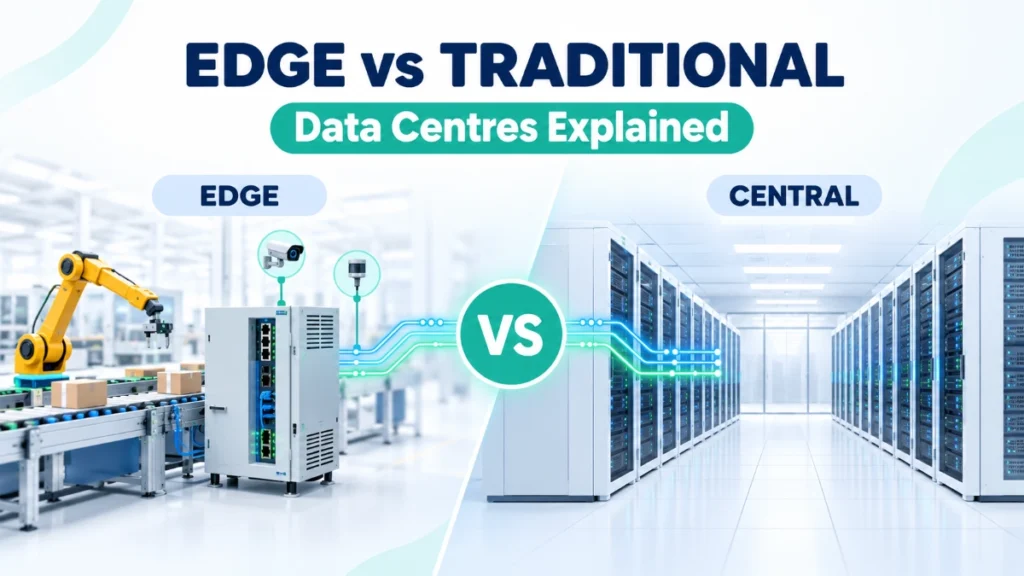
Now picture a different business. It runs finance software, customer databases, shared applications, and backups for employees in several offices. Here, a central data centre makes sense. The IT team manages servers, storage, and security from one place, and every office uses the same resources.
These two situations raise one question: should a business process data close to where it is generated, or rely mainly on a central facility? That question sits at the heart of edge data centres vs traditional data centres.
Both approaches have a place in modern IT. Neither is a universal winner. Edge is not automatically faster, and traditional is not outdated. The right choice depends on the workload, response-time needs, connectivity, security, cost, and how your team will operate the infrastructure.
This guide explains each model in plain language, compares them side by side, and shows how to decide which one, or which combination, fits your business.
What Is a Traditional Data Centre?
A traditional data centre brings computing, storage, networking, power, cooling, and management systems together in a centralised facility. A company may run its own, rent space in a colocation facility, or use infrastructure hosted by a service provider.
Think of a company that keeps its finance system, customer database, business applications, and backups in one main facility. Staff in every office connect to those shared resources over the network. The IT team patches, monitors, and secures everything from one location.
This approach offers clear advantages:
- Centralised management and administration.
- Consolidated computing and storage resources.
- Shared security and operational processes.
- Infrastructure that multiple teams or locations can pool.
It also has limits. Remote users and devices depend on network connectivity to reach central resources. Some workloads may see delays or consume heavy bandwidth when they send large volumes of data to a distant site.
“Traditional” does not mean old or inefficient. Modern centralised data centres use advanced networking, automation, virtualisation, and cloud technologies.
What Is an Edge Data Centre?
An edge data centre is a smaller or geographically distributed computing facility placed closer to the users, devices, or systems it serves. It can process, store, filter, or forward data locally instead of sending every operation to a distant central site.
Take a factory that analyses machine-sensor data on site. The local system spots an abnormal condition quickly, while only selected information goes to a central platform for long-term analysis.
Common characteristics include:
- Deployment near users, machines, branches, or data sources.
- Support for local processing and storage.
- Potential to reduce the data sent over wide-area links.
- Coordination with central data centres or cloud services when needed.
Edge data centres vary widely in size and purpose. Some occupy dedicated facilities. Others use compact infrastructure in industrial sites, telecom locations, or regional facilities.
Keep the two terms apart. Edge computing describes where processing happens, and it can run on small local systems. An edge data centre is a facility. An industrial gateway or small computer can perform edge computing without qualifying as a data centre.
Edge Data Centres vs Traditional Data Centres: Key Differences
The table below summarises how the two approaches typically compare.
| Factor | Edge data centres | Traditional data centres |
|---|---|---|
| Location | Closer to users, devices, or operations | Usually centralised in a dedicated or shared facility |
| Main purpose | Process data near its source or destination | Provide centralised computing, storage, and services |
| Response time | Can reduce network-related delay for suitable workloads | Depends on the distance, network path, and workload |
| Bandwidth | Can reduce traffic sent to central facilities | May carry substantial traffic from distributed locations |
| Scale | Often distributed across multiple locations | Resources commonly consolidated in fewer facilities |
| Management | Requires coordination across distributed sites | Can simplify central oversight, depending on the deployment |
| Physical environment | May operate in varied locations with different constraints | Usually operates in a purpose-built or professionally managed facility |
| Resilience | Can keep selected local functions running during some network disruptions | Can centralise resilience and recovery, but remote users may depend on connectivity |
| Cost considerations | More sites can increase deployment and maintenance complexity | Consolidation can improve resource sharing but may require significant central infrastructure |
Treat these as typical patterns, not absolute rules. Modern central data centres can be geographically distributed. Edge deployments can be managed centrally from one console.
Also avoid shortcuts such as “edge always costs less” or “central is always more secure.” Results depend on design, location, workload, connectivity, and operating model. Compare real requirements, not labels.
Why Does Location Matter for Data Processing?
Where you place computing resources affects performance and operating cost. Five factors explain why.
- Latency: The delay between sending data and receiving a response.
- Bandwidth: How much data a network connection can carry.
- Data volume: How much information sensors, cameras, machines, and applications generate.
- Connectivity: Whether the site has dependable access to central systems or cloud platforms.
- Local response needs: Whether an application must act quickly on nearby data.
Consider a plant with industrial cameras that inspect products. Each camera can produce a steady video stream. Sending every raw stream to a distant site uses a lot of bandwidth. A local system can analyse the footage, flag defects, and forward only selected clips or results.
Contrast that with a central business database serving several offices. Everyone needs the same records, so shared infrastructure in one place works well.
One caution: placing compute closer to a device can reduce network-related delay, but it does not guarantee a particular response time. Processing speed, application design, network congestion, and the full communication path also matter.
Advantages and Limitations of Edge Data Centres
Advantages
- Local processing reduces dependence on distant round trips for suitable applications.
- Filtering data near its source can cut wide-area network traffic.
- Selected local services may keep running during some disruptions to external connectivity.
- Distributed deployment supports geographically dispersed operations.
- Some workloads respond more quickly when the application and its data stay local.
Limitations
- Multiple sites increase maintenance and monitoring effort.
- Small facilities may offer less space, power, cooling, or room to expand.
- Physical security and environmental conditions vary by location.
- Distributed infrastructure demands careful software, security, and configuration management.
- Data synchronisation with central platforms needs planning.
For example, a plant that analyses vibration data locally may catch a fault sooner. But its team must now patch, monitor, and secure that local system too.
Edge works best when a workload has a clear reason to run locally, not simply because edge computing is popular.
Advantages and Limitations of Traditional Data Centres
Centralised data centres remain valuable because they concentrate resources and control. Their main strengths include:
- Consolidated computing and storage resources.
- Central administration and operational oversight.
- Shared infrastructure for multiple applications and business units.
- Support for large databases, enterprise systems, backups, and central analytics.
- Consistent access controls, monitoring, and maintenance procedures.
They also carry limitations:
- Remote applications depend on suitable network connectivity.
- Sending large data volumes from many locations can consume bandwidth.
- Some applications may see extra network delay when they talk to distant resources.
- Centralised infrastructure can concentrate dependencies if resilience and recovery are poorly designed.
A central data centre does not automatically deliver better security or reliability. Both depend on architecture, controls, operations, and regular testing.
Nor are these facilities obsolete. They suit many enterprise, cloud, storage, and high-performance computing workloads, and they will keep doing so.
When Should a Business Choose Edge or Traditional Data Centres?
Edge data centres may suit:
- Smart factories that process machine or sensor data locally.
- Industrial environments that need timely local responses.
- Video analytics deployments that would otherwise ship large amounts of raw footage to a central site.
- Remote branches or facilities with intermittent connectivity.
- Distributed operations where local services must continue during some network disruptions.
Traditional data centres may suit:
- Central enterprise databases and business applications.
- Shared computing and storage used by many departments.
- Centralised backup, analytics, and management systems.
- Workloads that do not need local processing at every site.
- Organisations that benefit from consolidating infrastructure and operations.
Many businesses do not have to pick just one. A hybrid approach places time-sensitive processing at the edge and uses central data centres or cloud platforms for long-term storage, enterprise applications, analytics, and coordinated management.
Example: An Indian manufacturer runs several plants. At each plant, a local system analyses sensor data and supports selected operations, so a short link problem does not stop the line. A central facility collects production reports from every plant, runs company-wide analytics, and hosts the ERP system. Each layer does the job it suits best. This is a planning scenario, not a real Comxus deployment.
Networking Requirements for Edge and Traditional Data Centres
Both models need solid networking, but their priorities can differ. Plan for these areas:
- Switching: Connecting servers, storage, machines, and other network devices.
- Uplink capacity: Enough bandwidth between local systems and central infrastructure.
- Redundancy: Alternative paths where availability needs justify them.
- Segmentation and access control: Separating traffic and limiting unauthorised communication.
- Monitoring: Watching link status, errors, traffic levels, and device health.
- Remote management: Helping teams administer distributed locations consistently.
- Physical and environmental conditions: Choosing equipment that suits the actual installation.
In industrial edge deployments, temperature, vibration, dust, cabinet space, and power availability can shape equipment choices. That does not mean every edge location needs industrial-grade hardware. A clean, climate-controlled branch room has different needs from a factory floor.
Requirements always depend on the application and the environment. Comxus works in industrial networking, and the network linking machines, edge sites, and central systems is where that experience applies.
Common Mistakes When Choosing Between Edge and Traditional Data Centres
Avoid these planning errors:
- Choosing edge infrastructure without a clear local processing requirement.
- Assuming edge computing automatically eliminates latency.
- Ignoring connectivity between distributed sites and central systems.
- Underestimating remote maintenance and security needs.
- Sending all raw data to a central facility when local filtering would work.
- Distributing workloads without planning data synchronisation and recovery.
- Choosing infrastructure on initial purchase cost alone.
- Overlooking power, cooling, space, and future growth.
The fix is simple: analyse each workload first, then let that analysis guide where it runs.
Frequently Asked Questions
The main difference is location and processing approach. An edge data centre sits closer to users, devices, or operations and processes data locally. A traditional data centre consolidates computing, storage, and management in a central facility.
Not automatically. Edge deployments can reduce network-related delay for local workloads. Actual performance still depends on the application, processing capacity, and the full network path.
Not always. Cost depends on scale, number of locations, power and cooling, connectivity, maintenance, and operational requirements. Several small sites can cost more to run than one consolidated facility, or less if they cut heavy data transfer.
Yes, and many do. A hybrid design assigns each workload to the location that fits its requirements, such as time-sensitive processing at the edge and enterprise applications in a central facility.
Conclusion
Edge data centres bring computing closer to users, devices, or operations. Traditional data centres consolidate resources in central facilities. Neither approach wins in every situation.
When you compare edge data centres vs traditional data centres, weigh latency, data volumes, connectivity, security, resilience, management effort, and long-term cost. Then choose infrastructure based on where data needs to be processed, how quickly systems must respond, and how your organisation will manage the network over time.
Read Also: How to Reduce Packet Loss in a Data Centre Network
Read Also: What Is Spine-Leaf Architecture in a Data Centre?
