
India’s factories are changing fast. Automation, real-time data and connected machines are no longer optional; they are the backbone of modern production.
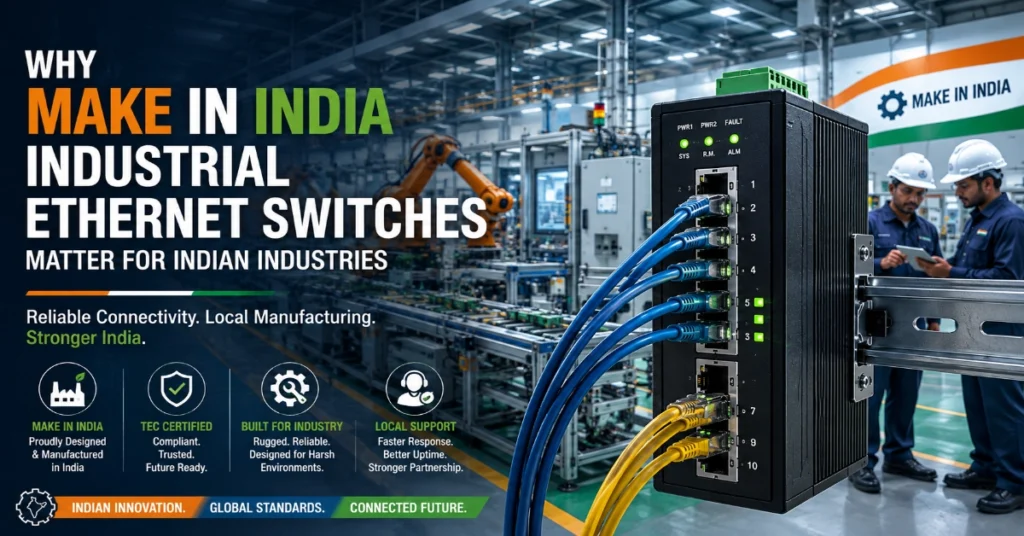
At the centre of this shift sits a small but critical device: the industrial Ethernet switch. And increasingly, Make in India industrial Ethernet switches are becoming the preferred choice for plant managers who need reliability without the delays of imported hardware.
This article explains why local manufacturing of industrial networking gear matters, what it means for uptime and compliance and how Indian OEMs are reshaping factory connectivity.
What Are Industrial Ethernet Switches?
An industrial Ethernet switch connects machines, sensors, controllers and cameras on a factory floor into one communication network.
Unlike office-grade switches, these devices are built to survive heat, dust, vibration and voltage fluctuations. They keep data moving even in harsh conditions.
Industrial switches typically support:
- Wide operating temperature ranges
- DIN-rail or panel mounting
- Redundant power inputs
- Ring or mesh network redundancy (like RSTP)
- Protection against electrical surges and interference
In a plant, even a few seconds of network downtime can stop a production line. That is why switch quality directly affects operational output.
Why This Matters More Than Ever
As factories add more sensors, robots and PLCs, the network carrying that data becomes as important as the machines themselves.
Importance of Local Manufacturing in India
For years, Indian industries relied heavily on imported networking hardware. This worked, but it came with hidden costs: long lead times, currency fluctuations and limited after-sales support.
Make in India industrial Ethernet switches address these gaps directly.
When switches are designed and assembled in India, manufacturers can respond faster to local requirements, voltage standards, environmental conditions and industry-specific protocols.
Local manufacturing also reduces dependency on global shipping disruptions, which have repeatedly affected electronics supply chains in recent years.
A Shift in Procurement Thinking
Procurement teams are now evaluating not just price, but supply security. A switch that arrives in days instead of months keeps expansion projects on schedule.
Supply Chain and Service Advantages
One of the strongest arguments for choosing an Indian industrial switch OEM is service speed.
When something fails on a production line, every hour of downtime has a cost. Local manufacturers can typically offer:
- Faster replacement units
- On-ground technical support
- Easier warranty and repair processing
- Better spare parts availability
This is a practical advantage that imported brands often cannot match, simply due to distance and time zones.
Shorter Distance, Faster Resolution
A support call answered by an engineer who understands Indian plant conditions tends to resolve issues faster than one routed through an overseas helpdesk.
Cost and Customisation Benefits
Indian-made switches often come with a cost advantage, since they avoid heavy import duties and long freight costs.
But the bigger benefit is customisation. Local OEMs can modify port configurations, mounting options, or firmware features to match a specific plant’s needs something large multinational vendors rarely offer for smaller order volumes.
This flexibility is especially useful for:
- System integrators building custom automation panels
- Utilities with unique protocol requirements
- Facilities retrofitting older infrastructure
Industrial networking solutions India-wide are increasingly being built around this kind of tailored approach, rather than one-size-fits-all imports.
Compliance and TEC Certification
Compliance is not a formality; it is a safeguard for network reliability and safety.
TEC-certified industrial switches are tested against standards set by India’s Telecommunication Engineering Centre, ensuring the equipment meets electrical safety, EMI/EMC, and performance requirements for use in Indian conditions.
For government projects, power utilities and infrastructure tenders, TEC certification is often mandatory. Choosing a certified industrial Ethernet switch manufacturer India partner simplifies vendor approval and reduces compliance risk later in a project.
Why Certification Builds Trust
A certified product signals that a manufacturer has invested in testing, documentation, and quality processes, not just assembly.
Industry Applications Across India
Industrial Ethernet switches are used far beyond factory floors. Some common sectors include:
Manufacturing and Automation
Switches connect PLCs, robotic arms, HMIs and sensors, forming the backbone of automated production lines.
Power and Energy
Substations and grid infrastructure rely on ruggedised switches to transmit monitoring and control data reliably, even in electrically noisy environments.
Transportation
Metro rail systems, traffic control and railway signalling depend on switches that can handle vibration and continuous operation.
Water Treatment
SCADA systems in water and wastewater plants use industrial switches to monitor pumps, valves and flow sensors across large sites.
Oil, Gas, and Process Industries
Explosion-conscious environments require switches built for extreme durability and long-term unattended operation.
Role in Industry 4.0 and Smart Factories
Smart manufacturing depends on constant, reliable data flow between machines, sensors, and control systems.
Smart manufacturing India initiatives are pushing plants toward predictive maintenance, real-time monitoring and centralised dashboards, all of which need a stable network foundation.
Industrial Ethernet switches enable this by supporting:
- Time-sensitive data for coordinated machine actions
- Network segmentation for safety-critical zones
- Redundant paths so a single cable failure does not halt production
Without dependable switching infrastructure, Industry 4.0 goals like predictive analytics and remote monitoring simply cannot function at scale.
The Network Is the New Factory Floor
As more decisions rely on real-time data, the switch layer becomes as operationally important as the equipment it connects.
Why Indian OEMs Are Becoming Preferred Partners
Beyond cost, Indian OEMs are winning trust for a simple reason: accountability.
When the manufacturer, support team and service centre are all within the country, communication is faster, and problem-solving is more direct.
This is influencing decisions across sectors from mid-sized manufacturers to large infrastructure projects where long-term partnership matters more than a one-time purchase.
How Comxus Supports Indian Industries
Comxus is an Indian OEM brand focused on industrial Ethernet switches and TEC-certified industrial networking solutions engineered for local conditions.
By designing and manufacturing within India, Comxus aims to give plant managers, system integrators, and procurement teams a networking partner that understands local voltage standards, environmental challenges, and compliance requirements with support that doesn’t depend on overseas timelines.
This approach reflects a broader industry trend: choosing networking infrastructure built with local expertise, not just assembled for the local market.
Conclusion
As Indian industries scale up automation and digital infrastructure, the case for Make in India industrial Ethernet switches grows stronger.
Local manufacturing brings faster support, easier compliance, practical customisation, and supply chain resilience advantages that directly affect uptime and long-term operating costs.
For plant managers and engineers planning the next phase of factory connectivity, choosing a certified, locally engineered switch is no longer just a patriotic preference. It is a practical decision that supports reliability, growth, and India’s broader manufacturing ambitions.
Read Also: Top 5 Features in Industrial Ethernet Switches
Read Also: Industrial Network Security Secrets No One Talks About
