
A production machine on the factory floor is constantly generating data: temperature readings, vibration signatures, energy consumption, cycle counts, machine status. That data has value, but only if it actually gets somewhere useful: collected locally, processed close to the machine, and in many cases forwarded to a factory server or cloud platform.
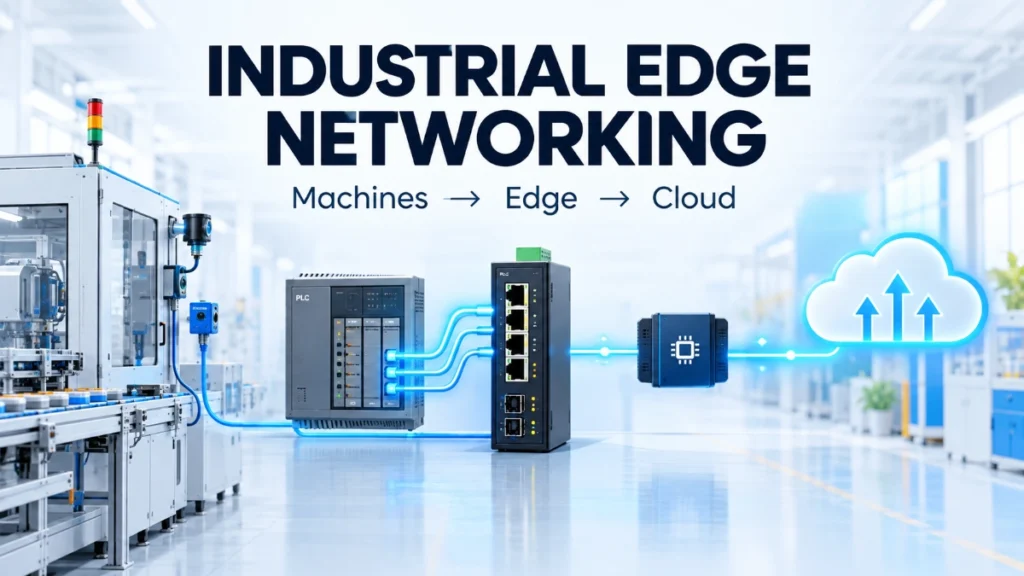
So how does that data actually move from the machine to the cloud?
The answer starts with industrial edge networking. Industrial Ethernet is one of the key layers in this path, physically and logically connecting machines, PLCs, sensors, edge devices, industrial PCs, and the IT and cloud systems above them.
What Is Industrial Edge Networking?
Industrial edge networking is the network infrastructure that connects industrial machines, controllers, sensors, edge devices, and local computing systems so data can be collected and processed closer to where it is generated.
In a factory context, “the edge” isn’t a single device; it’s a layer that sits between the machines on the plant floor and the broader IT or cloud environment. Rather than every data point travelling straight to a distant server, it’s gathered and often processed near its source first.
This shift happens because factories generate more data than it’s practical or necessary to send elsewhere in raw form. Industrial Ethernet provides the physical and logical connectivity that ties machines to this local computing layer and, importantly, the cloud doesn’t disappear from the picture. It remains part of the architecture, just not the first stop for every piece of data.
From Machine to Cloud: How Industrial Data Moves
A common (though not universal) data path looks like this:
Machine/Sensor → PLC/Controller → Industrial Ethernet Switch → Edge Device/Industrial PC → Factory Network → Cloud Platform
- Machines and sensors generate raw operational data: temperature, speed, vibration, output counts.
- PLC/controller collects and acts on machine-level information in real time.
- An industrial Ethernet switch provides the network connectivity linking PLCs, sensors, and other devices together.
- Edge device/industrial PC processes, filters, aggregates, or analyses data locally before it goes further.
- Factory/enterprise network provides controlled, managed connectivity toward IT systems.
- Cloud platform stores, analyses, visualises, or correlates data across machines or sites.
Not every industrial architecture follows this exact structure; some skip local edge processing, others add additional layers, but this flow illustrates the general path most IIoT data travels.
Why Put Computing at the Industrial Edge?
Processing data near the machine, rather than sending everything to the cloud, offers several practical advantages:
- Less dependence on constant cloud connectivity.
- Faster local data handling for operational decisions.
- Reduced bandwidth requirements.
- The ability to filter out unnecessary data before transmission.
- Better support for time-sensitive local applications.
- Continued local operation even if cloud connectivity is interrupted.
For example, a single machine might generate thousands of sensor readings per hour, but an edge system may only forward selected events, trends, alarms, or summarised data to the cloud rather than the entire raw stream. This isn’t about guaranteeing a specific latency figure; it’s about reducing unnecessary data movement and keeping critical decisions close to the source.
What Role Does an Industrial Ethernet Switch Play at the Edge?
The industrial Ethernet switch is part of the connectivity layer linking machines to edge computing systems; it’s the hardware that makes the network physically work.
A switch in this role typically connects:
- PLCs
- Remote I/O
- Sensors and controllers using Ethernet-based communication
- Industrial PCs and edge gateways
- Uplinks to higher-level factory or IT networks
Depending on the application, that connectivity may run over copper Ethernet, fibre, or SFP uplinks for longer distances. Switches can also support network segmentation, traffic management, and diagnostics, but not every deployment needs all of these capabilities.
There’s a meaningful difference between basic connectivity and managed industrial networking. A small, simple machine cell may only need reliable point-to-point connections. A larger, multi-cell facility with mixed traffic types may need more visibility and control. Switch requirements ultimately depend on network size, architecture, protocols in use, reliability needs, environmental conditions, and how much monitoring is required.
Managed vs Unmanaged Switches at the Industrial Edge
Unmanaged industrial Ethernet switches work well when the network architecture is simple, basic connectivity is enough, and there’s limited need for configuration or diagnostics.
Managed industrial Ethernet switches become useful when the network requires VLANs, QoS (quality of service), monitoring, port-level diagnostics, redundancy features, traffic prioritisation, or greater overall visibility and control.
Managed doesn’t automatically mean better; it means more capable for networks that actually need those capabilities. The right choice depends on the specific requirements of the network, not a blanket rule.
Industrial Edge Networking and IIoT
Industrial Ethernet supports many IIoT applications, including machine condition monitoring, predictive maintenance, energy monitoring, production analytics, equipment performance tracking, environmental monitoring, and remote diagnostics.
It’s worth emphasising: IIoT isn’t simply about connecting every machine directly to the internet. In a well-designed architecture, industrial data moves through controlled OT and edge infrastructure switches, gateways, and industrial PCs before it ever reaches enterprise or cloud systems. That controlled path is a defining feature of practical IIoT networking, not an afterthought.
How Edge Networking Helps Connect OT and IT
IT/OT convergence refers to bringing operational technology (the machines and controllers on the floor) and information technology (servers, databases, cloud systems) into a more connected, coordinated architecture.
- OT side: PLCs, HMIs, industrial controllers, machines, sensors, industrial Ethernet.
- Edge layer: Edge gateways, industrial PCs, local analytics, data aggregation.
- IT/cloud side: Servers, databases, analytics platforms, cloud applications.
The edge layer acts as an intermediate zone rather than exposing every machine directly to external networks. This supports more structured, manageable convergence, though it’s worth noting that edge networking alone doesn’t make an OT network secure; effective cybersecurity requires multiple layers of controls working together.
What Should You Consider When Designing an Industrial Edge Network?
- Network topology: Star, line, ring, or another architecture suited to the application.
- Port requirements: Number and type of Ethernet ports needed.
- Uplink requirements: Copper, fibre, or SFP depending on distance.
- Traffic requirements: Standard traffic vs. high-bandwidth devices, video, or IIoT data.
- Protocol compatibility: The industrial protocols used by connected equipment.
- Environmental conditions: Temperature, vibration, electrical noise, enclosure needs.
- Management and diagnostics: Whether managed features are actually required.
- Reliability and redundancy: Whether redundant paths are needed.
- Security architecture: Segmentation and access control rather than direct public internet exposure.
Example: Industrial Edge Network Architecture
PLC + Sensors + HMI → Industrial Ethernet Switch → Industrial PC/Edge Gateway → Factory Network → Cloud/Analytics Platform
In practice: the PLC collects machine data, the switch connects industrial devices, the edge computer processes selected data, the local system generates alarms or basic analytics, and only relevant information is forwarded to enterprise or cloud systems.
Common Mistakes in Industrial Edge Networking
- Sending every machine’s raw data directly to the cloud.
- Ignoring network segmentation.
- Choosing switches based only on port count.
- Overlooking environmental specifications.
- Underestimating uplink bandwidth needs.
- Failing to plan for diagnostics and troubleshooting.
- Mixing IT and OT requirements without a clear architecture.
- Assuming every IIoT application needs cloud connectivity.
- Ignoring redundancy where it’s actually needed.
- Treating the industrial switch as just a connectivity device.
Conclusion
The path from machine to cloud generally follows a consistent pattern: Machines → Industrial Ethernet → Edge → Factory/IT → Cloud. Industrial edge networking provides the connectivity layer that makes it possible to move meaningful data from the production floor toward local computing and higher-level systems.
Comxus designs industrial Ethernet switches built for this connectivity layer, helping engineers and integrators select the right switch based on their application’s topology, environment, bandwidth, management, and reliability requirements.
Read Also: How to Troubleshoot Packet Loss in Industrial Ethernet
Read Also: IEEE 802.1AS Explained: Time Synchronisation in TSN
