
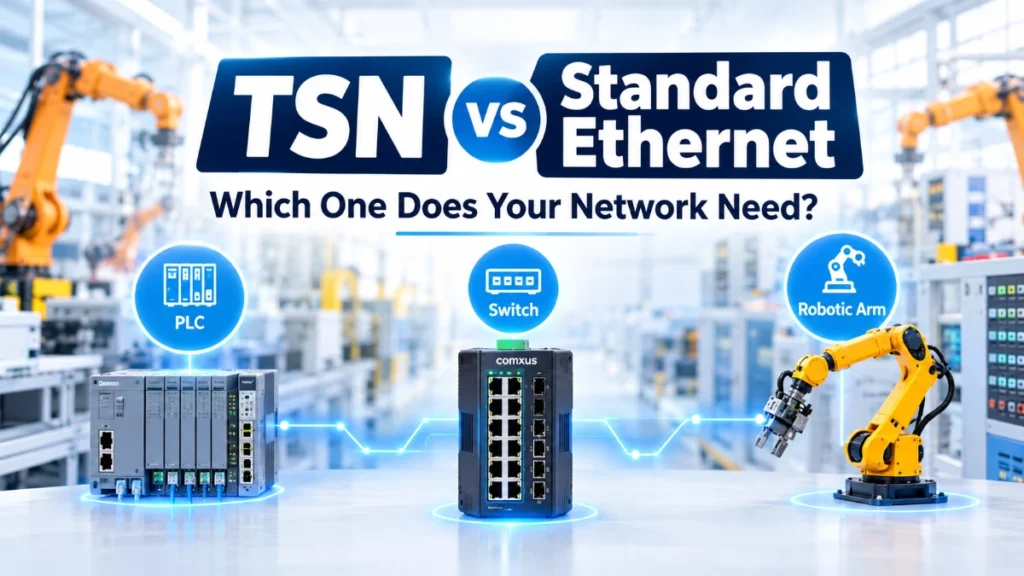
On a modern factory floor, a robotic arm, a vision system, and a PLC often need to act within microseconds of each other. Standard Ethernet handles most industrial traffic well, but it wasn’t built for guaranteed timing. This is where the TSN vs Standard Ethernet comparison becomes critical because in automation, a few milliseconds of unpredictable delay can throw an entire process out of sync.
What Is Standard Ethernet?
Standard Ethernet is the conventional networking technology used across offices and many industrial environments. It moves data using best-effort delivery; packets are sent and switched without guaranteed arrival times. Industrial Ethernet variants add ruggedness and reliability, but timing still depends on network load. For many applications, data logging, HMI communication, and general monitoring, this level of performance is more than sufficient.
What Is Time-Sensitive Networking (TSN)?
Time-Sensitive Networking (TSN) is a set of IEEE standards that add deterministic, time-aware communication to standard Ethernet. In simple terms, TSN allows every device on a network to share a common clock and communicate on a predictable schedule. It reduces jitter, prioritises critical traffic and guarantees that time-sensitive data arrives exactly when expected. TSN doesn’t replace Ethernet; it extends it, enabling standard hardware to deliver industrial-grade timing precision without a separate, proprietary fieldbus.
TSN vs Standard Ethernet: What Actually Changes?
The core difference lies in predictability. Standard Ethernet transmits data as it becomes available so that latency can vary depending on network traffic. TSN reserves bandwidth and schedules transmission windows, keeping latency and jitter within tight, known limits.
| Factor | Standard Ethernet | TSN |
|---|---|---|
| Timing | Best-effort | Scheduled, synchronised |
| Latency | Variable | Predictable, bounded |
| Jitter | Can be high | Minimized |
| Prioritization | Basic QoS | Traffic-class scheduling |
| Synchronization | None built-in | Network-wide clock sync |
In practice, TSN doesn’t make a network faster; it makes it more consistent, which matters far more in coordinated automation tasks than raw speed.
Why Latency and Jitter Matter in Industrial Automation
In automation, timing consistency often matters more than speed itself. A PLC controlling a conveyor, a robotic arm performing pick-and-place motion, or a machine vision system triggering an inspection all depend on synchronised signals. If latency varies unpredictably jitter, motion control loops can drift, vision triggers can misfire, and synchronised machines can fall out of step, leading to quality issues or safety concerns.
How TSN Makes Ethernet More Deterministic
TSN achieves determinism through a few key mechanisms. IEEE 802.1AS establishes precise time synchronisation across all devices on the network, giving every node a shared sense of “now.” IEEE 802.1Qbv introduces time-aware traffic scheduling, opening and closing transmission gates so critical data always has a reserved slot. Frame preemption allows urgent, time-sensitive frames to interrupt lower-priority traffic mid-transmission rather than waiting in queue. Together, these mechanisms don’t just prioritise traffic; they coordinate exactly when each device is allowed to transmit, removing the unpredictability inherent in standard Ethernet switching.
TSN in Industrial Automation
TSN is increasingly used wherever tight coordination is essential. In robotics and motion control, it keeps multiple axes synchronised down to microseconds. In machine vision, it ensures triggers and image capture align precisely with production timing. Smart factories use TSN to merge operational technology (OT) and IT traffic on a single network without sacrificing determinism. It also supports Industrial IoT and edge computing setups, where sensor data and control commands must coexist reliably on the same infrastructure.
Do Industrial Ethernet Switches Need to Support TSN?
Not every industrial Ethernet switch is TSN-capable. Conventional switches handle standard QoS and VLAN segmentation but lack time synchronisation and scheduled traffic control. TSN-capable switches support features like 802.1AS clock sync, 802.1Qbv scheduling, and preemption, alongside standard functions like VLANs and network management. For applications that don’t need microsecond-level timing, a conventional switch is fine. But for deterministic control loops, TSN-aware hardware is compatibility-critical.
TSN vs Standard Ethernet: Which Should an Industrial Network Use?
There’s no universal answer; it depends on what the application demands. Standard Ethernet remains suitable for monitoring, data collection, and less time-critical communication where occasional delay is tolerable. TSN becomes necessary when synchronisation, low jitter, and guaranteed latency directly affect machine performance or safety, such as multi-axis motion control or tightly coupled robotic cells. The right choice comes down to evaluating determinism requirements against system complexity and cost, not defaulting to the newer technology by assumption.
What Should Engineers Check Before Adopting TSN?
Before adopting TSN, engineers should verify a few practical points:
- Does the application genuinely require deterministic timing, or is standard Ethernet sufficient?
- Are connected devices and controllers TSN-compatible?
- Do existing switches support the required TSN standards?
- Is the network architecture designed for synchronised time distribution?
- Is there room for future expansion without redesigning the topology?
Answering these honestly prevents costly over-engineering or under-provisioning.
TSN and the Future of Industrial Networking
TSN is becoming a foundational technology for Industry 4.0 and smart manufacturing, enabling IT/OT convergence on a single network. As Industrial IoT and edge computing expand, the demand for synchronised, low-latency communication across mixed traffic types will only grow, making TSN adoption more relevant across a wider range of industrial systems.
Industrial Networking OEM Considerations
When selecting industrial networking equipment, organisations should evaluate standards compliance, timing accuracy, build quality, and long-term support. Indian industrial networking OEMs like Comxus are increasingly offering TSN-ready and conventional industrial Ethernet switches, giving engineers domestically supported options suited to varied automation requirements.
Conclusion
Standard Ethernet remains a reliable choice for many industrial applications, while TSN adds the deterministic timing, synchronisation, and scheduling needed for tightly coordinated automation tasks. The right approach isn’t choosing one over the other by default; it’s letting actual latency, jitter, and synchronisation requirements guide the decision. Engineers who assess these needs upfront avoid both underperformance and unnecessary complexity.
Read Also: PROFINET Networking: How Industrial Ethernet Switches Support Automation Systems
Read Also: Understanding DIN-Rail Industrial Ethernet Switches
