
Walk into any modern industrial control panel, and you’ll notice a familiar pattern: PLCs, circuit breakers, terminal blocks and power supplies all clipped neatly onto a metal rail, wired in an organised row. Networking equipment needs to fit into that same layout. This is exactly why DIN-rail industrial Ethernet switches exist: they let engineers add reliable network connectivity to a panel without breaking the tidy, standardised structure that panel builders and maintenance teams depend on.
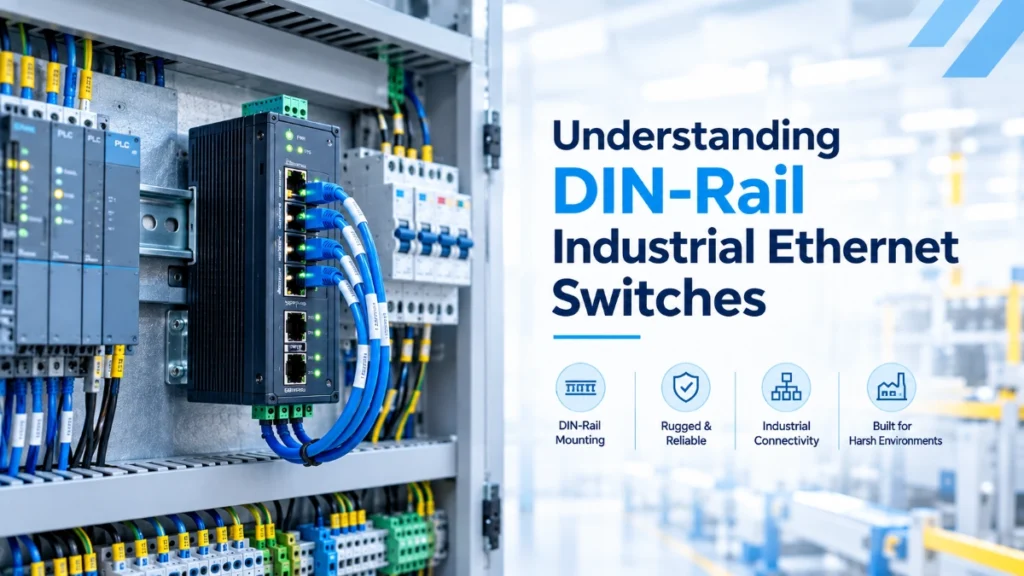
As factories, utilities and infrastructure projects connect more devices, sensors, drives, cameras, controllers, the network backbone carrying that data needs to survive the same harsh conditions as the equipment around it. A DIN-rail industrial Ethernet switch is built for exactly that job.
What Is a DIN-Rail Industrial Ethernet Switch?
A DIN-rail industrial Ethernet switch is a network switch designed to mount on a standard DIN rail inside industrial enclosures, built to handle vibration, temperature extremes and electrical noise that would affect standard office networking equipment.
To understand this properly, it helps to break the term into its parts.
An Ethernet switch connects multiple devices PLCs, HMIs, sensors, cameras, computers on the same network, allowing them to exchange data efficiently. It reads the destination of each data packet and forwards it only where needed, rather than broadcasting everywhere.
What makes a switch “industrial” is its construction and tolerance for harsh environments:
- Metal housings instead of plastic
- Wide operating temperature ranges
- Resistance to vibration and shock
- DC power input suited to control panel power systems
- Longer service life expectations
DIN-rail mounting refers to the standardised metal rail (typically the 35 mm profile defined by DIN EN 60715) used throughout industrial control panels. A switch with a DIN-rail clip on its back simply snaps onto this rail alongside other panel components.
Conventional office switches, by contrast, are designed for climate-controlled server rooms, sit on desks or in racks, and are rarely built to handle dust, moisture, or continuous vibration conditions that are routine on a factory floor.
Why Is DIN-Rail Mounting Used in Industrial Networks?
DIN-rail mounting isn’t just a formality; it solves practical problems that panel builders face every day.
- Space-efficient installation: Switches sit alongside PLCs and relays without needing separate mounting brackets or shelving.
- Faster panel assembly: Electricians and integrators are already familiar with DIN-rail components, so wiring and installation follow a consistent process.
- Organised panel layouts: A row of DIN-rail devices keeps panels visually clean and easier to document and inspect.
- Simpler maintenance: A faulty switch can be unclipped and replaced quickly, without rewiring the whole panel.
- Compatibility with existing infrastructure: Most industrial control panels are already built around DIN-rail standards, so the switch fits naturally into that ecosystem.
Key Features of DIN-Rail Industrial Ethernet Switches
Not every DIN-rail industrial Ethernet switch includes every feature below; specifications vary by model and intended application. Here are the features commonly found across the category:
- Industrial Ethernet ports: RJ45 ports rated for repeated industrial use, often with locking or secure connector options.
- Fast Ethernet and Gigabit Ethernet: Depending on the model, ports may support 10/100 Mbps or up to 1000 Mbps for higher data throughput.
- Fiber/SFP uplinks: Useful for connecting panels over longer distances or where electrical isolation from noise is needed.
- Industrial DC power input: Typically 12–48V DC, matching common control panel power supplies rather than standard AC mains.
- Redundant power inputs: Dual power inputs allow the switch to keep running if one power source fails.
- Managed or unmanaged operation: Some switches offer configuration and monitoring; others operate as simple plug-and-play devices.
- Network redundancy features: Ring protocols or similar mechanisms that allow the network to recover quickly if a cable link fails (typically found in managed switches).
- LED status indicators: Provide a quick visual check of power, link, and port activity without needing a laptop.
- Industrial operating temperature range: Many models are rated from around -10°C to 60°C or wider, depending on design.
Managed vs Unmanaged DIN-Rail Switches
The difference between managed and unmanaged switches comes down to configurability. Unmanaged switches work automatically with no setup, while managed switches allow configuration, monitoring, and traffic control through a web interface or software tool.
An unmanaged switch is essentially plug-and-play. You connect the cables, apply power, and devices start communicating. This is often sufficient for smaller networks with straightforward, unchanging device connections, for example, a single machine cell or a small panel with a handful of sensors and a PLC.
A managed switch offers more control and visibility, which becomes valuable as networks grow in size or importance. Typical managed features include:
- VLANs to logically separate traffic (for example, isolating a camera network from a control network).
- Port monitoring to track traffic, errors, or link status on individual ports.
- Traffic management through prioritisation (QoS) for time-sensitive data.
- Diagnostics for troubleshooting connectivity issues remotely.
- Network redundancy protocols that reroute traffic automatically if a cable fails, reducing downtime.
For critical processes where a network fault could stop production or affect safety systems, a managed industrial Ethernet switch is generally the more practical choice.
Where Are DIN-Rail Industrial Ethernet Switches Used?
DIN-rail industrial Ethernet switches appear across a wide range of sectors wherever equipment needs reliable, panel-mounted connectivity:
- Factory automation connecting PLCs, drives, and I/O modules on the plant floor.
- Industrial control panels as the core networking component inside cabinets.
- PLC and SCADA networks linking controllers to supervisory systems.
- Machine networking connecting sensors and actuators within a single machine or cell.
- CCTV and IP surveillance supporting camera networks in industrial and infrastructure sites.
- Energy and power infrastructure substations, switchgear rooms, and power distribution networks.
- Transportation systems signalling cabinets, trackside equipment, and station networking.
- Water and wastewater facilities connecting remote pump stations and treatment monitoring equipment.
- Outdoor industrial networks where suitably rated switches support exposed installations.
- Remote monitoring systems transmitting data from unattended or distributed sites.
DIN-Rail Ethernet Switches for Outdoor Industrial Networks
DIN-rail mounting does not, by itself, make a switch suitable for outdoor use. Outdoor installations bring additional environmental stress that indoor-rated switches aren’t necessarily built to handle, so specifications need to be checked carefully rather than assumed.
Factors to consider for outdoor or exposed installations include:
- Temperature variations: wider daily and seasonal swings than indoor panels experience.
- Dust and moisture often require the switch to sit inside a sealed, weatherproof enclosure.
- Vibration is relevant near heavy machinery, rail lines, or roadside installations.
- Electrical interference from nearby power equipment, motors, or lightning-prone areas.
- Outdoor enclosures rated appropriately (commonly IP65 or higher) to protect the switch itself.
- Power protection surge protection for power and data lines in exposed locations.
- Fibre connectivity is often preferred over copper for longer outdoor cable runs, due to better noise immunity and distance capability.
An outdoor industrial network switch setup typically combines a DIN-rail switch with appropriate temperature ratings, placed inside a purpose-built outdoor cabinet, rather than relying on mounting type alone.
How to Choose the Right DIN-Rail Industrial Ethernet Switch
Choosing a DIN-rail industrial Ethernet switch involves matching port count, speed, power input, environmental rating, and redundancy features to the specific application, while also considering future network expansion.
A practical checklist to work through:
- Number of Ethernet ports needed now, plus some allowance for future devices.
- Port speed: Fast Ethernet (100 Mbps) or Gigabit Ethernet, based on data volume.
- SFP/fiber requirements needed for longer distances or noisy environments.
- Power input voltage range compatible with the panel’s existing power supply.
- Redundant power requirements important for critical or continuous processes.
- Managed or unmanaged operation based on how much visibility and control is needed.
- Network redundancy ring or similar protocols for applications where downtime is costly.
- Operating temperature range matched to the actual panel or site conditions.
- Mounting requirements confirming DIN-rail compatibility and panel space.
- Future expansion leaving headroom for additional devices or network segments.
- Technical support and warranty availability, including documentation and assistance if issues arise.
Why DIN-Rail Switches Matter for Modern Industrial Networking
As factories move toward Industry 4.0 and greater automation, the number of connected devices on the plant floor keeps growing. Machines, sensors, drives, and monitoring systems increasingly need to share data with higher-level systems to support smart factory operations and industrial IoT applications.
None of this works without a stable physical network. DIN-rail industrial Ethernet switches form part of that foundation, sitting quietly inside panels while carrying the traffic that keeps automated systems, remote monitoring, and connected machines communicating reliably.
Choosing an Indian Industrial Networking OEM
When evaluating a supplier for industrial Ethernet networking equipment, it helps to look beyond the switch specification sheet alone. Relevant factors include:
- Product range: whether the OEM offers switches across different port counts, speeds, and mounting types.
- Technical specifications: clearly documented power, temperature, and connectivity details.
- Application support guidance on selecting the right switch for a given panel or site.
- Product documentation: datasheets, manuals, and wiring references.
- Customisation possibilities where applicable, for specific project requirements.
- Warranty terms and coverage offered on the product.
- Local technical assistance availability of support within India, which can simplify troubleshooting and replacement timelines.
Comxus is one of the Indian industrial networking OEMs offering DIN-rail industrial Ethernet switches for control panel and automation applications. As with any supplier, buyers should review the specific product documentation and specifications against their application needs before making a decision.
Conclusion
DIN-rail industrial Ethernet switches solve a practical problem: how to bring reliable network connectivity into industrial control panels without disrupting the organised, standardised layout that panel builders rely on. They’re built to handle the temperature swings, vibration, and electrical noise found in industrial settings conditions that ordinary office equipment isn’t designed for.
The right switch for any given project depends on the details: how many ports are needed, what speed the application demands, how power is supplied, what the environmental conditions look like, whether redundancy matters, and how much room is needed for future growth. Working through these factors carefully, rather than picking a switch based on mounting type alone, is what leads to a dependable industrial network.
Read Also: What Is a Good PoE Budget for an Industrial PoE Switch?
Read Also: Common Industrial Network Failures and How to Prevent Them
