
Should Indian industries choose imported industrial switches or locally manufactured alternatives?
It’s a question that comes up in almost every automation network upgrade, factory expansion or infrastructure project, and it rarely has a one-line answer.
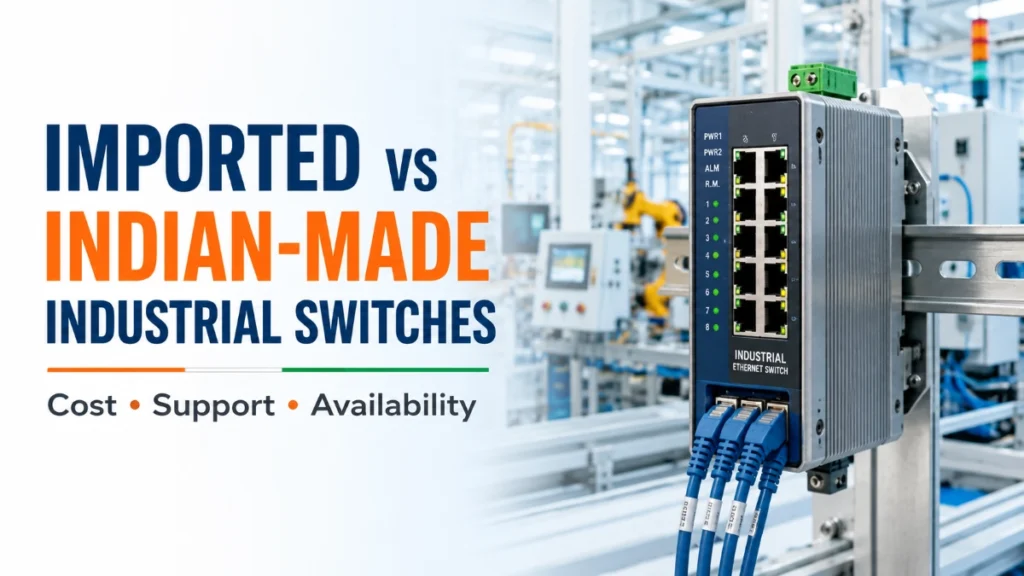
Industrial Ethernet switches sit at the core of manufacturing lines, SCADA systems, building automation and process control networks. A switch failure isn’t just an IT inconvenience; it can stop a production line or disrupt safety-critical monitoring. That’s why the decision to buy imported or Indian-made industrial switches deserves more thought than simply comparing price tags on a quotation sheet. Total cost of ownership, technical support, spare parts availability, customisation, warranty terms, compliance and long-term reliability all factor into what actually turns out to be the better investment.
This article breaks down the practical differences so procurement teams, system integrators and automation engineers can make an evidence-based decision rather than a purely price-based one.
Imported vs Indian-Made Industrial Switches: What’s the Difference?
Imported industrial switches typically come from established global brands with decades of engineering history, deep product catalogues, and a strong reputation in specific verticals like oil & gas, rail, or heavy process industries. They can be a good fit when a project specifically requires a certified product line or a protocol stack the buyer has already standardised on.
Indian-made industrial switches, manufactured by domestic OEMs, are built and engineered within the country, which changes the dynamics of communication, lead time and after-sales support. They’re increasingly used across factory automation, panel building, water treatment and infrastructure projects where local responsiveness matters as much as the hardware itself.
Neither category is universally “better”; the right choice depends on the specific project, the criticality of the application and how the buyer weighs cost against support and availability.
1. Initial Cost vs Total Cost of Ownership
The purchase price on an imported switch’s datasheet often looks competitive, but it rarely reflects the full cost of getting that switch running and keeping it running for years.
Additional costs that show up later include:
- Freight, customs duties, and currency fluctuation on repeat orders
- Extended lead times that force larger safety-stock inventory
- Shipping costs and delays for warranty replacements
- Downtime while waiting for a replacement unit to arrive from overseas
- Higher-cost or slower technical support engagements
Indian-made switches can reduce several of these variables simply because manufacturing, stocking, and support happen domestically. That said, the actual total cost of ownership still depends on the specific product, the vendor’s support model, and the project’s scale; it isn’t automatic just because a switch is locally made.
2. Technical Support and Response Time
When a network goes down on a production floor, the speed and clarity of support matter more than almost anything else.
Local support typically offers:
- Communication in familiar time zones and without language friction
- Faster escalation paths since the support team and manufacturing are often under one roof
- On-site visits that are logistically easier to arrange
- Remote troubleshooting without waiting for overseas support desks to open
Imported switches from global brands can still offer strong support through regional distributors or local system integrators, but the buyer should verify exactly who is responsible for support in India, and how quickly they can respond; this varies significantly by brand and by distributor, not by import status alone.
3. Product Availability and Lead Times
Local manufacturing can shorten lead times for both new orders and spares, since products don’t have to clear customs or travel long distances. This is a real advantage in many cases, but it isn’t a universal rule; availability still depends on the manufacturer’s own inventory planning, component sourcing, and production capacity.
Buyers should ask any supplier, Indian or imported, for realistic lead times on the specific model they need rather than assuming faster delivery based on country of origin alone.
4. Customisation for Industrial Applications
Industrial projects often need switches configured to their specific environment: a certain mix of copper and fibre ports, PoE budgets, DIN-rail or panel mounting, extended operating temperature ranges, or specific redundancy protocols like RSTP or ring topologies.
Working directly with an Indian OEM can make this conversation easier: design queries, firmware requests and configuration changes can often be discussed directly with local engineering teams, without routing through multiple layers of an international distribution chain.
5. Compliance and Certification
Buyers should independently verify which certifications and regulatory requirements apply to their specific project and industry; these vary by application, sector and end customer, and shouldn’t be assumed. It’s worth confirming directly with the manufacturer which certifications a given switch model holds, rather than relying on general claims about imported or Indian-made products as a category.
6. Reliability in Indian Industrial Environments
Reliability comes down to the specifications of the actual product, not whether it was imported or made in India. Buyers evaluating any industrial switch should check:
- Operating temperature range for their installation environment
- Vibration and shock resistance
- Industrial-grade metal enclosure rating
- Power input redundancy
- Surge and EMI/EMC protection
- DIN-rail mounting compatibility
- Network redundancy features (ring protocols, link aggregation)
- Ingress protection where the switch is exposed to dust or moisture
A well-engineered Indian-made switch can match imported alternatives on these parameters; a poorly specified switch from either origin can fail in demanding conditions.
7. Import vs Indian-Made Industrial Switches: Quick Comparison
| Factor | Imported Switches | Indian-Made Switches |
|---|---|---|
| Initial purchase cost | Often higher, subject to currency and duty impact | Can be more competitive, but varies by manufacturer |
| Local technical support | Depends on distributor/local presence | Typically direct and faster to arrange |
| Availability | Subject to shipping and customs timelines | Often shorter, depending on manufacturer stock |
| Customization | Possible, usually through longer channels | Easier direct engagement with local OEM |
| Spare parts | May involve import delays | Generally faster domestic replacement |
| Communication with manufacturer | Multiple layers, time zone gaps | Direct, fewer intermediaries |
| Project-specific requirements | Case-by-case, brand-dependent | Often easier to discuss and adapt |
| Supply-chain considerations | Exposed to global logistics disruptions | Less exposed, but depends on component sourcing |
8. When Should You Choose an Indian Industrial Switch?
An Indian-made switch is often worth prioritising when a project needs:
- Fast local technical support and on-site troubleshooting.
- Custom port, power, or mounting configurations.
- Shorter communication cycles with the manufacturer’s engineering team.
- Domestic supply continuity for ongoing or multi-phase projects.
- A long-term OEM relationship rather than a one-time purchase.
What Should Buyers Check Before Selecting a Switch?
Regardless of origin, a practical checklist should include:
- Number and type of ports (copper, fibre, combo)
- Managed vs unmanaged functionality
- Gigabit or higher throughput capability
- PoE requirements and power budget
- Network redundancy support
- Operating temperature range
- Power input options (DC, redundant inputs)
- Mounting method (DIN-rail, rack, wall)
- Applicable certifications for the project
- Warranty terms and coverage
- Availability of technical support
- Spare parts and replacement lead time
- Manufacturer’s track record in similar applications
Comxus: An Indian Approach to Industrial Networking
Comxus is an Indian industrial networking OEM that designs and manufactures industrial Ethernet switches domestically, working directly with system integrators and automation teams on application-specific requirements.
The value of working with a manufacturer like Comxus lies less in a single feature and more in the overall engagement model: local engineering support, the ability to discuss customisation directly and manufacturing based in India for industrial and automation use cases.
As with any supplier, buyers should evaluate the specific product’s specifications and support terms against their project requirements rather than choosing based on origin alone.
Conclusion
The choice between imported and Indian-made industrial switches isn’t really “imported vs Indian-made”; it’s a question of which supplier’s total value proposition fits the project. Cost, reliability, technical support, availability, customisation, compliance and total cost of ownership all need to be weighed together. Buyers who evaluate switches this way, rather than on upfront price alone, are far more likely to end up with a network that holds up over the life of the project.
Read Also: What Is TEC Certification and Why Is It Important for Industrial Switches?
Read Also: Benefits of Choosing an Indian OEM for Industrial Network Switches
