
Network downtime is one of the most expensive problems any business can face today. Choosing the right redundancy protocol RSTP or ERPS can be the difference between a five-second failover and a five-minute outage. This guide breaks down both technologies in plain terms so you can make the smartest choice for your network.
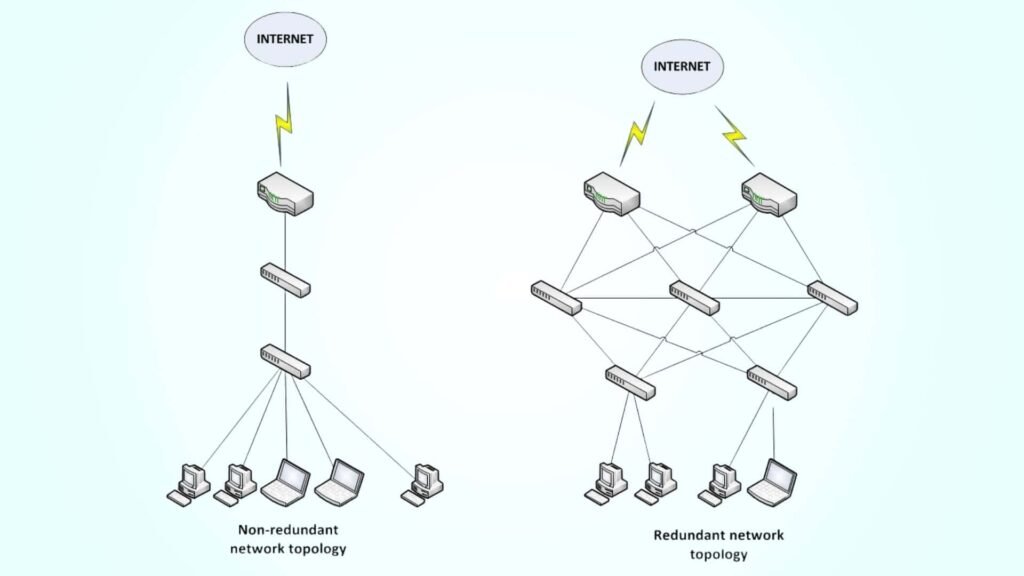
Network redundancy means having backup paths so traffic keeps flowing when a link fails. Without redundancy, a single cable cut can take down your entire operation instantly.
Modern enterprise and industrial networks simply cannot afford that kind of single point of failure.
Redundancy protocols manage these backup paths automatically without human intervention. They detect failures and reroute traffic within milliseconds, keeping services alive.
Understanding these protocols is the first step toward building a truly resilient network infrastructure.
Two protocols dominate the conversation around Ethernet redundancy today: RSTP and ERPS. RSTP stands for Rapid Spanning Tree Protocol, defined under IEEE 802.1w.
ERPS stands for Ethernet Ring Protection Switching, governed by ITU-T G.8032. Both solve the same core problem loops and redundancy but they take very different approaches. Knowing the difference helps you design networks that are fast, stable, and reliable. Let us explore each one in depth before comparing them head-to-head.
What Is RSTP? How It Works?
RSTP is an evolution of the original Spanning Tree Protocol (STP), introduced decades ago to prevent loops in Ethernet networks. STP was notoriously slow, taking up to 50 seconds to reconverge after a topology change. RSTP dramatically reduced that time to just 1–2 seconds in most scenarios.
It achieves this through a smarter port state machine and faster handshake mechanisms between switches.
RSTP was standardized as IEEE 802.1w and later absorbed into IEEE 802.1D-2004. Today, it is the baseline redundancy protocol in virtually every managed network switch on the market.
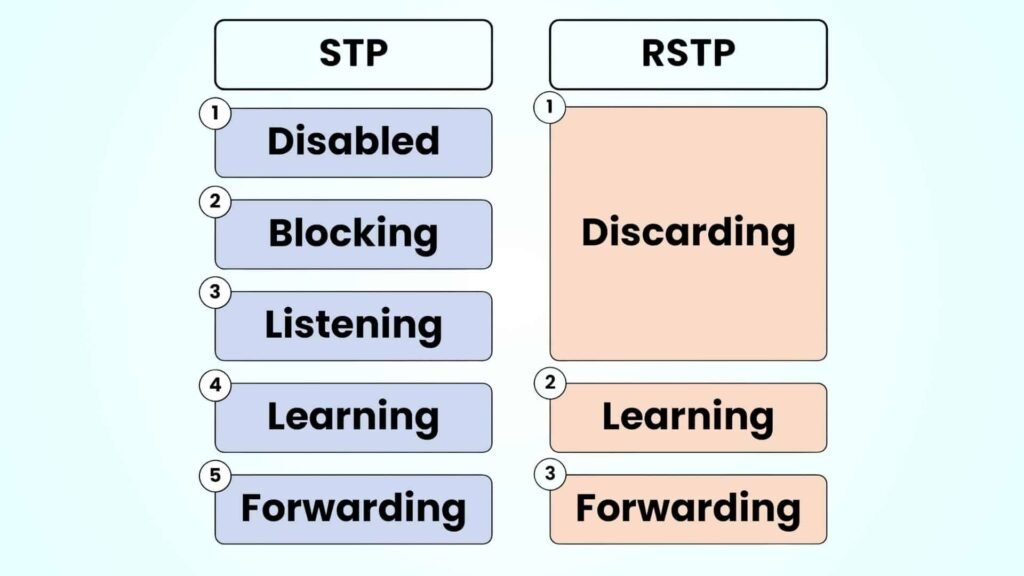
RSTP works by building a loop-free logical tree across your network topology. It elects a Root Bridge, which acts as the logical center of the network tree. All other switches calculate the shortest path to the Root Bridge and block redundant ports.
When a link goes down, RSTP quickly recalculates the tree and unblocks the next-best path. This process is called topology reconvergence, and with RSTP it takes roughly one to two seconds.
The protocol uses port roles Root, Designated, Alternate, and Backup to manage path selection intelligently.
RSTP Port States and Roles
RSTP simplifies STP’s five port states down to just three: Discarding, Learning, and Forwarding. This simplification accelerates the transition process significantly.
The Discarding state combines STP’s old Blocking, Listening, and Disabled states into one. The Learning state allows the switch to build its MAC address table without forwarding frames.
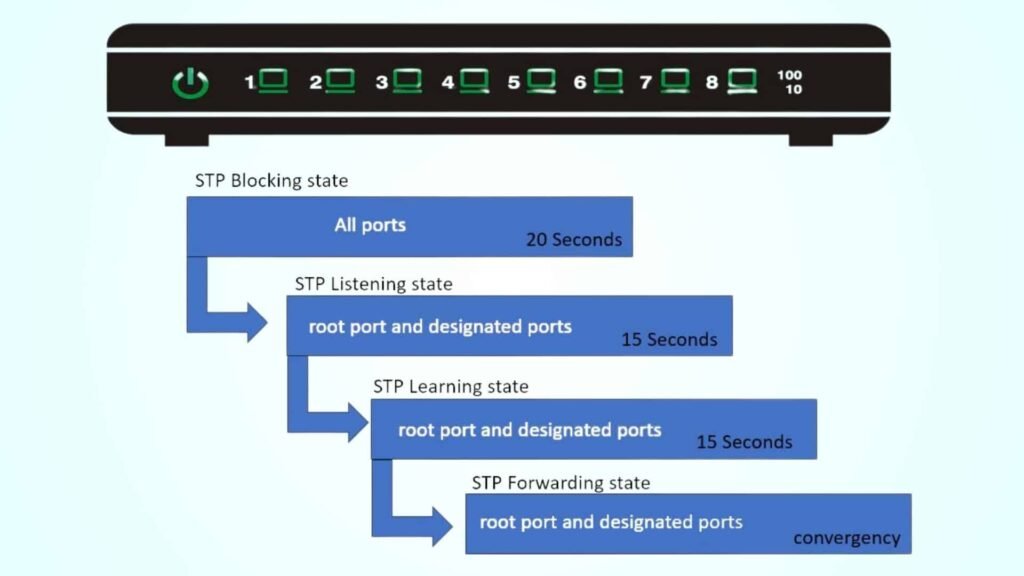
The Forwarding state is the normal operational state where traffic flows freely. Understanding these states helps engineers troubleshoot convergence issues faster and more accurately.
What Is ERPS And How It Works?
ERPS was designed specifically for ring-based network topologies, which are common in industrial automation and carrier-grade networks. Unlike RSTP’s tree model, ERPS embraces the physical ring and manages it elegantly. It was defined by the ITU-T G.8032 standard and later extended to support multi-ring and ladder topologies.
The protocol’s primary job is to block one link in the ring called the Ring Protection Link (RPL) to prevent loops. When a failure occurs, the RPL is unblocked and traffic reroutes through it instantly. ERPS can achieve failover times of less than 50 milliseconds, making it ideal for time-sensitive applications.
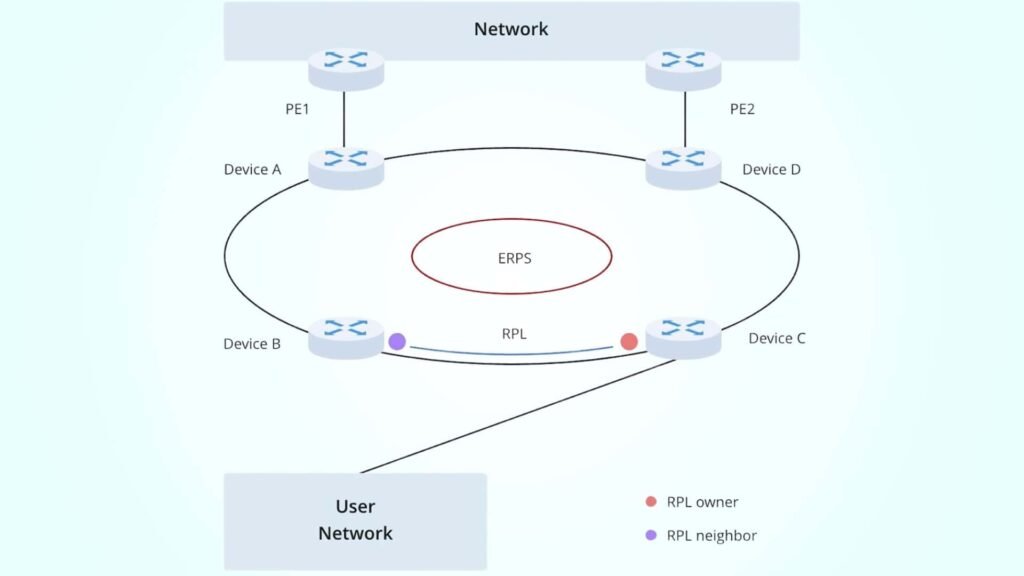
ERPS nodes communicate using Ring Automatic Protection Switching (R-APS) messages sent over the ring. Each node in the ring acts as either a Ring Protection Link Owner (RPL Owner) or a regular ring node. The RPL Owner manages the blocked port and coordinates recovery.
When a failure is detected, the failed node sends an R-APS signal to notify all other nodes immediately. The RPL Owner then unblocks the RPL, and all nodes flush their MAC tables and update their forwarding paths.
This entire process happens in sub-50ms, which is why ERPS is favored in industrial and telecom environments.
ERPS version 2 (G.8032v2) introduced support for multiple rings, sub-rings, and interconnected rings greatly expanding its applicability in complex carrier and industrial network designs.
RSTP vs ERPS: Head-to-Head Comparison
Now that we understand how each protocol works independently, let us compare them directly. The differences are significant and go beyond just failover speed.
Network topology, scale, industry use case, and configuration complexity all play a role. The table below summarizes the most important technical and operational differences.
Use this as a quick reference when evaluating your own network design. A deeper discussion of each point follows in the sections below.
| Feature / Criterion | RSTP (IEEE 802.1w) | ERPS (ITU-T G.8032) |
| Topology Support | Tree, Mesh, Star | Ring (single, multi, sub-ring) |
| Failover Speed | 1–2 seconds | < 50 milliseconds |
| Standard Body | IEEE 802.1w / 802.1D | ITU-T G.8032 |
| Loop Prevention | Blocks redundant ports via tree | Blocks RPL in ring |
| Scalability | High (large mesh networks) | Medium (ring-constrained) |
| Configuration | Moderate complexity | More complex but deterministic |
| Use Cases | Enterprise LAN, data centers | Industrial, telecom, carrier Ethernet |
| Protocol Messages | BPDUs (Bridge Protocol Data Units) | R-APS (Ring APS messages) |
| MAC Table Flush | On topology change | On every protection switch event |
| Bandwidth Efficiency | Unused links are blocked | RPL is blocked; all others active |
| Industry Adoption | Universal in IT networks | Strong in OT / industrial Ethernet |
Failover Speed: The Most Critical Difference
When a network link fails, speed of recovery is everything in time-sensitive environments. RSTP typically reconverges in 1 to 2 seconds, which is acceptable for most enterprise IT networks.
However, in industrial automation, even a one-second outage can halt an assembly line or disrupt a SCADA system. ERPS was engineered to overcome this limitation with sub-50ms failover times.
Some implementations achieve failover in as little as 10–30 milliseconds depending on ring size.
This speed advantage makes ERPS the go-to choice in environments where deterministic, near-instant recovery is non-negotiable.
It is worth noting that RSTP’s convergence time can vary depending on network size and configuration. Larger trees with many switches take longer to reconverge compared to smaller ones.
ERPS, by contrast, has more predictable and deterministic failover behavior because the ring topology is constrained and well-defined.
The R-APS message propagation time is proportional only to ring circumference. This predictability is a major reason carriers and industrial operators prefer ERPS.
When you need guaranteed SLA-level recovery times, ERPS is simply the stronger choice.
Topology Fit: Which Protocol Matches Your Network Design?
Your physical network topology should heavily influence which protocol you choose. RSTP is designed for tree, mesh, and star topologies and handles irregular network layouts gracefully. Most enterprise campus networks and data centers use these irregular topologies.
RSTP automatically computes the best tree regardless of how switches are connected together. It handles complex, multi-vendor environments with ease due to its universal IEEE standardization.
If your network does not follow a strict ring layout, RSTP is almost always the more practical and flexible choice.
ERPS, on the other hand, requires a deliberate ring topology to function correctly. You must physically lay out your network as a ring for ERPS to deliver its benefits.
This makes it ideal for planned deployments like factory floors, substations, and metro Ethernet rings. Industrial Ethernet standards such as IEC 62439 often reference ERPS-compatible solutions.
Sub-ring and multi-ring extensions in G.8032v2 add some flexibility to this constraint. Still, if your environment is not ring-based, adopting ERPS would require a significant infrastructure redesign.
Use Cases: Where Each Protocol Excels
RSTP is the dominant protocol in enterprise IT environments like office buildings, campuses, and data centers. It handles dynamic, growing networks where new switches are frequently added or removed.
Network administrators are highly familiar with STP/RSTP troubleshooting and configuration. Most managed switches from entry-level to enterpriseship with RSTP enabled by default.
It is also compatible with Multiple Spanning Tree Protocol (MSTP), which extends redundancy across multiple VLANs. For general-purpose IT networking, RSTP remains the gold standard after more than two decades of use.
ERPS shines brightest in Operational Technology (OT) and industrial Ethernet environments. Power utilities, oil and gas pipelines, railway signaling, and smart factory automation all rely on it.
These industries demand the deterministic sub-50ms recovery that only ERPS can reliably provide. Carrier Ethernet providers also use ERPS to build resilient metro Ethernet ring networks for business customers.
It is commonly found in equipment from vendors like Cisco, Hirschmann, Belden, and Moxa in industrial settings. If uptime is measured in milliseconds and not seconds, ERPS is the right tool for the job.
Configuration Complexity and Interoperability
RSTP configuration is generally straightforward on most managed switches today. You set bridge priorities, port costs, and edge port designations to tune the topology.
Most switches handle RSTP automatically with minimal manual tuning required. Because it is an IEEE standard, RSTP works seamlessly across switches from different vendors.
This multi-vendor interoperability is a huge advantage in heterogeneous enterprise environments. Even engineers with modest networking experience can deploy and maintain RSTP effectively.
ERPS requires more careful planning and deliberate configuration upfront. You must correctly identify the RPL Owner node, configure ring IDs, and map physical port roles.
Misconfigurations in an ERPS ring can cause unexpected loops or blackholes in traffic. That said, once correctly configured, ERPS behavior is highly predictable and deterministic.
Interoperability between vendors can sometimes be a challenge with ERPS, so testing in mixed environments is advised. The added configuration effort pays dividends in environments where failover speed is a hard requirement.
Final Verdict: Which Protocol Should You Choose?’
Choose RSTP if you run a traditional enterprise IT network with a tree or mesh topology. It is universally supported, easy to configure, and perfectly adequate for most business networking needs.
Choose ERPS if you operate industrial, telecom, or carrier Ethernet networks built on physical ring topologies. Its sub-50ms failover speed and deterministic behavior are unmatched when milliseconds matter.
In some advanced deployments, both protocols can coexist RSTP handling the core network and ERPS protecting individual ring segments. Understanding both gives network engineers maximum flexibility in designing resilient, high-availability infrastructures.
