
Industrial networks are under more pressure than ever before. With the rise of Industry 4.0, IIoT devices, and smart factory deployments, managing network traffic has become mission-critical. One powerful but often overlooked feature is IGMP Snooping a Layer 2 protocol intelligence mechanism.
It plays a vital role in keeping industrial Ethernet switches efficient and reliable. Understanding it can make the difference between a smooth production floor and a congested, failure-prone OT network.
What Is IGMP Snooping?
IGMP stands for Internet Group Management Protocol, a network-layer protocol used to manage multicast group memberships. Multicast allows a single data stream to be sent to multiple recipients simultaneously, saving bandwidth. Without any intelligence at the switch level, multicast packets get flooded to every port — even ports with no interested receivers.
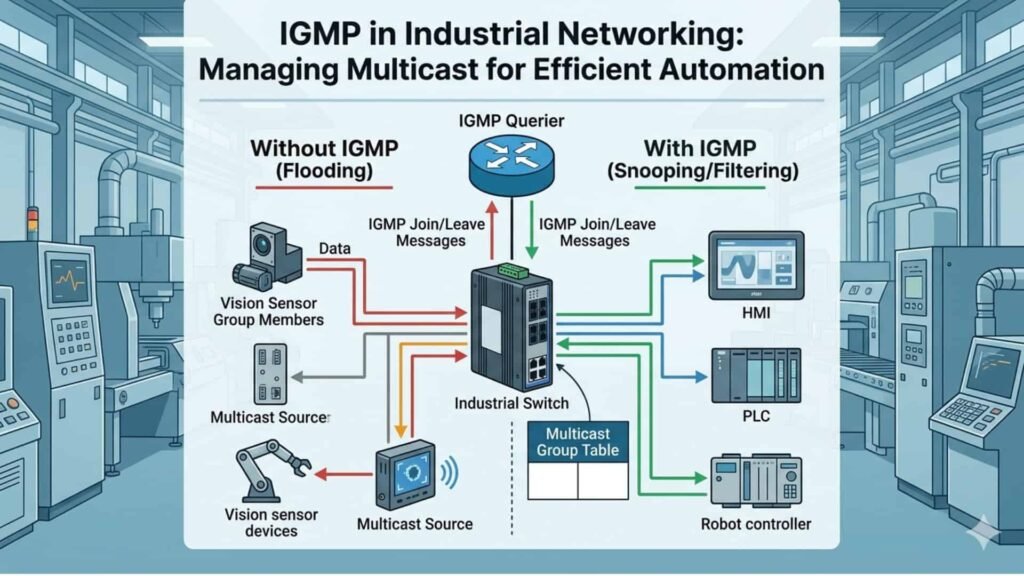
IGMP Snooping solves this problem by allowing the switch to “listen in” on IGMP conversations between hosts and routers. The switch then builds a table of which ports belong to which multicast groups.
In simple terms, the switch acts as a smart traffic controller for multicast data. It does not blindly forward multicast frames to all ports on a VLAN segment. Instead, it delivers multicast traffic only to ports that have actively joined the relevant group.
This makes IGMP Snooping a Layer 2 multicast optimization technique. It operates transparently without requiring changes to end devices or higher-level protocols. For industrial switches, this is not a luxury it is a necessity.
Quick Information
IGMP Snooping is a switch-level mechanism that monitors IGMP membership traffic between hosts and routers. It intelligently forwards multicast packets only to ports that need them, reducing unnecessary traffic across an industrial network.
How IGMP Snooping Works?
When a host device wants to receive a multicast stream, it sends an IGMP Join message to the network. A multicast router periodically sends IGMP Query messages to discover active group members. Without snooping, the switch has no way to distinguish multicast from broadcast traffic. IGMP Snooping enables the switch to intercept and analyze these IGMP messages in real time. The switch then updates its internal multicast forwarding table, also known as the Layer 2 multicast table.
When a device wants to leave a group, it sends an IGMP Leave message. The switch removes that port from the group’s forwarding entry immediately or after a leave delay timer. This dynamic updating ensures the forwarding table always reflects the current state of group memberships. The result is a highly efficient, real-time multicast delivery system at Layer 2. Industrial switches with IGMP Snooping support process these messages at wire speed with no noticeable latency impact.
“IGMP Snooping transforms a dumb multicast flood into an intelligent, targeted delivery system — essential for any serious industrial Ethernet deployment.”
| IGMP Query | Multicast Router | Forwards to all ports; identifies querier port |
| IGMP Report (Join) | Host Device | Adds port to multicast group entry |
| IGMP Leave | Host Device | Removes port; triggers Group-Specific Query |
| IGMP v3 Membership Report | Host Device | Updates source-specific multicast forwarding |
Why IGMP Snooping Matters in Industrial Networks?
Industrial environments use a wide range of multicast-heavy protocols and systems.
PROFINET, EtherNet/IP, GOOSE messaging in IEC 61850, and many SCADA systems all rely on multicast for real-time data distribution. Without IGMP Snooping, these multicast streams flood every port on the switch, consuming bandwidth on links that don’t need it.
In a manufacturing plant with hundreds of connected PLCs and sensors, this creates significant traffic overhead. Such unnecessary load can delay time-critical control signals and disrupt operations.
Industrial control systems have strict latency and determinism requirements that general IT networks do not. A flooded multicast stream can saturate a 100 Mbps link on a PLC panel and cause communication timeouts.
Real-time Ethernet protocols are especially sensitive to bandwidth fluctuations and congestion. IGMP Snooping keeps these critical paths clean and efficient by containing multicast to only the relevant network segments. It is particularly important in ring topologies and redundant industrial Ethernet architectures like MRP and RSTP.
OT (Operational Technology) networks are converging with IT infrastructure at an accelerating pace. This convergence brings higher traffic volumes and greater complexity to the factory floor and substation.
A single unmanaged multicast flood can impact dozens of field devices simultaneously. Industrial managed Ethernet switches with IGMP Snooping act as the first line of defense against such congestion events. Without it, even a well-designed network topology can suffer from preventable performance degradation.
Key Benefits of IGMP Snooping in Industrial Switches
| Bandwidth conservation: | Multicast frames are sent only to interested ports, freeing up capacity for critical control traffic on the same segment. | |
| Reduced CPU load on endpoints: | Devices no longer receive multicast frames they did not request, eliminating unnecessary interrupt processing at the firmware level. | |
| Improved determinism: | Real-time protocols like PROFINET and EtherNet/IP benefit directly from reduced background traffic and lower collision risk. | |
| Enhanced network security posture: | Limiting multicast scope reduces the attack surface for multicast-based exploits in OT environments. | |
| Better VLAN segmentation | IGMP Snooping works per-VLAN, allowing tight control of multicast boundaries in segmented industrial networks. | |
| Scalability support: | As IIoT device counts grow, snooping ensures the network scales without proportional increases in multicast flooding. |
Industrial Use Cases and Real-World Applications
Substation Automation using the IEC 61850 standard relies heavily on GOOSE (Generic Object-Oriented Substation Event) and SV (Sampled Values) multicast messages. These messages are time-critical and must reach specific IEDs (Intelligent Electronic Devices) within microseconds. Without IGMP Snooping, GOOSE packets flood all switch ports and consume bandwidth on links serving unrelated protection relays. Industrial switches deployed in substations must support IGMP Snooping to meet IEC 61850 performance requirements. This is a mandatory feature in many utility-grade switch specifications today.
In automotive assembly lines and discrete manufacturing, EtherNet/IP uses multicast for I/O connections between controllers and distributed field devices. Large assembly cells may have 50–100 EtherNet/IP devices active on a single VLAN at any given time. Without snooping, every multicast I/O packet is delivered to all 100 ports even printers and HMIs that don’t use EtherNet/IP. IGMP Snooping restricts this traffic to only the controller-to-device paths where it belongs. The result is a cleaner, faster, and more reliable automation network.
Video surveillance and IP camera networks in industrial facilities generate very high bandwidth multicast video streams. A single HD video stream can consume 4–10 Mbps per camera in a multicast configuration. In a plant with 200 cameras, unconstrained multicast flooding can overwhelm even a Gigabit network backbone. IGMP Snooping ensures that video streams only reach the NVRs and monitoring workstations that have explicitly subscribed to them. This is a classic example where snooping directly translates to cost savings on network infrastructure upgrades.
SCADA and DCS systems often use multicast for historian data publication and alarm broadcast. Operators need alarm events to reach specific workstations quickly without unnecessary delays caused by congested links. Industrial Ethernet switches with IGMP Snooping enable these systems to scale to hundreds of nodes without sacrificing response time. In redundant network designs with dual-ring or parallel redundancy, IGMP Snooping also prevents duplicate multicast floods from crippling the network. This makes it indispensable in process industries like oil and gas, water treatment, and power generation.
Configuring IGMP Snooping on Industrial Switches
Most modern managed industrial Ethernet switches support IGMP Snooping and enable it by default or with a single configuration command. The first step is to enable IGMP Snooping globally on the switch and then on specific VLANs where multicast traffic is present. You should also configure the IGMP Querier function if no dedicated multicast router exists in the network segment. The querier sends periodic IGMP Query messages to keep group membership tables fresh and up to date. Without a querier, snooping tables may time out and multicast forwarding may fail silently.
Setting the correct robustness variable and query interval is important for industrial reliability. A lower query interval means faster convergence after topology changes, but it also increases control traffic on the network. For most industrial environments, a query interval of 60–125 seconds is a reasonable starting point to balance responsiveness and overhead. The leave latency parameter controls how quickly a port is removed from a group after receiving a Leave message. In fast-moving industrial processes, setting this too high can cause unnecessary multicast delivery and waste bandwidth.
Industrial switches from vendors like Cisco IE, Moxa, Hirschmann, Phoenix Contact, and Belden all support IGMP Snooping with varying levels of configurability. CLI-based and web GUI-based configuration options are typically both available on these platforms. Always verify snooping status per VLAN, as some switches only enable it globally without activating it on individual VLANs. Testing the configuration using multicast traffic generators or protocol analyzers like Wireshark ensures the snooping table is being populated correctly. Document all snooping configurations as part of your network baseline for future audits and troubleshooting.
Best Practices for IGMP Snooping in OT Environments
Always enable IGMP Snooping on all managed industrial switches in your network, not just core or distribution switches. Access-layer switches connected directly to PLCs, sensors, and field devices are where flooding causes the most damage. Enable the IGMP Querier on at least one switch per VLAN if no multicast-capable router is present in the segment. Periodically verify the multicast forwarding table to ensure entries are being created and aged out correctly. Use network monitoring tools that support multicast group visualization to detect rogue or unexpected multicast sources early.
Avoid mixing IGMPv1, IGMPv2, and IGMPv3 devices on the same VLAN without understanding the compatibility implications for snooping behavior. IGMPv3 supports source-specific multicast (SSM), which provides more granular control but requires switch support for SSM-aware snooping. Always test interoperability in a lab environment before deploying mixed-version IGMP environments in production. For substations and power systems, adhere to IEEE 802.1Q and IEC 61850-8-1 recommendations for multicast configuration and snooping timers. Aligning your IGMP settings with industry standards reduces risk and simplifies compliance documentation.
In ring-topology networks using MRP (Media Redundancy Protocol) or RSTP, IGMP Snooping helps prevent multicast traffic from looping during topology reconvergence events. Ensure that the snooping implementation handles topology change notifications (TCNs) correctly by flushing or refreshing the multicast table promptly. Some older industrial switches have known bugs where IGMP snooping tables are not cleared after an RSTP topology change, causing traffic blackholes. Always check vendor firmware release notes for multicast-related bug fixes before deploying snooping in a redundant network. Firmware updates are a critical maintenance activity that directly impacts snooping reliability and overall network stability.
Conclusion
IGMP Snooping is one of the most impactful features you can enable on an industrial Ethernet switch today. It directly addresses the bandwidth waste and latency issues caused by uncontrolled multicast flooding in OT environments. From substation automation to smart manufacturing and IP video surveillance, the benefits are both measurable and immediate. Industrial network engineers who master IGMP Snooping gain a powerful tool for building scalable, deterministic, and resilient control networks. As IIoT adoption accelerates and multicast traffic volumes grow, this feature transitions from a best practice to an absolute requirement.
The difference between a well-configured industrial network and a poorly designed one often comes down to these foundational protocol features. Take the time to audit your existing switch configurations, enable snooping where it is missing, and align your settings with the demands of your specific industrial applications. Your PLCs, IEDs, and SCADA systems will thank you and so will your maintenance team during the next network troubleshooting session. Investing in proper multicast management today means fewer emergency calls and less unplanned downtime tomorrow. Build smarter industrial networks — start with IGMP Snooping.
