
SFP (Small Form-factor Pluggable) is a compact, hot-swappable network transceiver used in Ethernet switches, routers and other networking equipment. It allows a network device to connect using different types of fiber optic or copper interfaces without replacing the entire switch.
SFP is particularly useful in industrial networking because network connections may need to cover long distances, operate in electrically noisy environments, or connect different parts of a large facility.
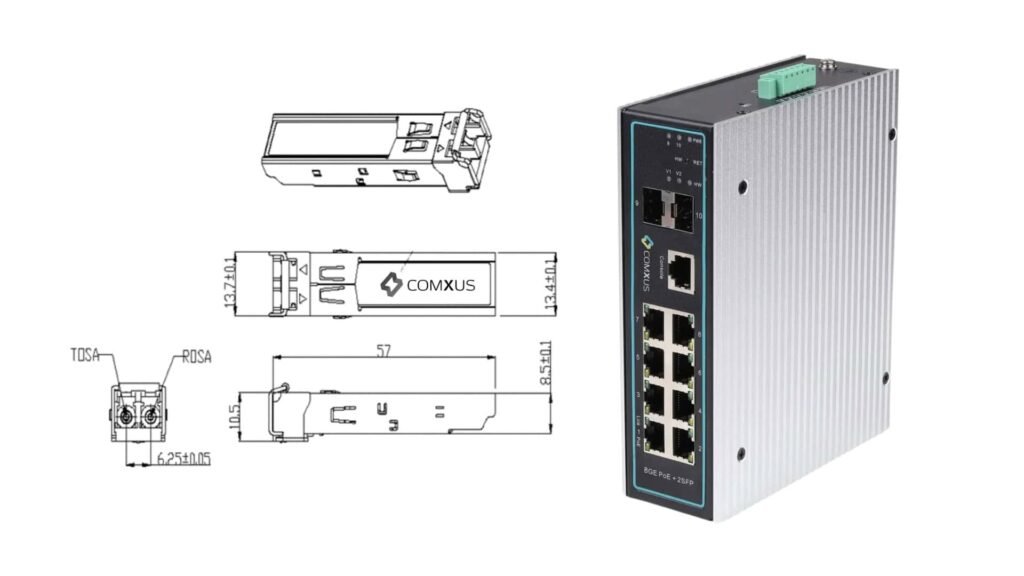
For applications such as CCTV surveillance, SCADA, PLC communication, industrial Ethernet and enterprise networking, SFP-based connectivity provides flexibility when designing network uplinks.
What Is an SFP Port?
An SFP port is a modular slot on a network device that accepts a compatible SFP transceiver. The SFP module determines the type of physical connection.
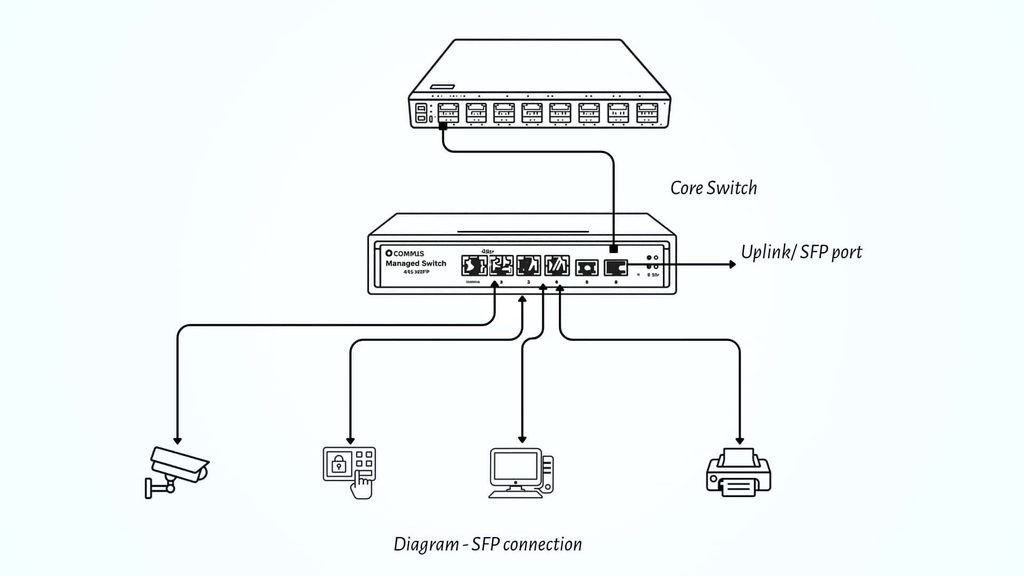
Instead of permanently building a switch with one specific fiber interface, an SFP slot allows the network engineer to select an appropriate transceiver based on the required fiber type, speed and transmission distance.
How Does SFP Work?
An SFP module converts electrical signals from the switch into optical signals when fiber is used.
The basic communication process is:
For copper-based SFP modules, the module provides an appropriate copper Ethernet interface instead of optical transmission. This modular approach makes SFP useful for network expansion and uplink design.
Where Are SFP Ports Used?
SFP ports are commonly used for:
- Switch-to-switch connections
- Fiber uplinks
- Long-distance Ethernet links
- Industrial network backbones
For example, an industrial plant may use copper Ethernet ports for cameras and PLCs while using SFP fiber ports to connect remote switches.
SFP and Fiber Optic Networking
One of the biggest advantages of SFP is its support for different fiber configurations.
Depending on the transceiver, an SFP connection may use:
- Single-mode fiber
- Multimode fiber
- Different optical wavelengths
- Different transmission distances
For example, a short-distance connection inside a plant may use one type of optical transceiver, while a longer connection between buildings may require a different module.
Therefore, engineers should match the SFP module with the fiber type, connector, wavelength, speed and required distance.
SFP vs SFP+
SFP and SFP+ are related but are designed for different Ethernet speeds.
| Feature | SFP | SFP+ |
| Common speed | Up to 1 Gbps | Up to 10 Gbps |
| Typical use | Gigabit uplinks | High-speed uplinks |
| Application | Access/distribution | Distribution/core |
| Form factor | Compact | Similar compact form factor |
A switch with SFP+ ports can provide significantly higher uplink capacity than a conventional 1G SFP interface.
For high-density CCTV systems, for example, a 10G SFP+ uplink can aggregate traffic from multiple 1G access ports.
What Should You Check Before Selecting an SFP?
Before installing an SFP module, check:
- Supported Ethernet speed
- Fiber type
- Transmission distance
- Optical wavelength
- Connector type
- Single-mode or multimode compatibility
- Switch compatibility
- Operating temperature
- Vendor coding requirements
- Optical power budget
For industrial installations, temperature specifications can be particularly important because network equipment may be installed outside conventional air-conditioned server rooms.
Frequently Asked Questions
What is an SFP port used for?
An SFP port is used to connect compatible transceiver modules for fiber or certain copper Ethernet connections, commonly for uplinks and long-distance network links.
Is SFP fiber or copper?
SFP is a transceiver form factor. Depending on the module, it can support fiber optic or copper Ethernet connectivity.
What is the difference between SFP and SFP+?
SFP is commonly associated with Gigabit Ethernet, while SFP+ is commonly used for 10 Gigabit Ethernet.
Can SFP be used for CCTV?
Yes. SFP and SFP+ interfaces are commonly used as fiber uplinks in large CCTV networks to aggregate traffic from multiple IP cameras and switches.
