
Industrial networks are handling more data than ever before. Modern automation systems depend on fast communication. I have seen networks fail due to bandwidth limitations. That is why high bandwidth industrial switches are becoming essential in today’s environments.
What is a High Bandwidth Industrial Switch?
A high bandwidth industrial switch is designed to handle large volumes of network traffic. It supports higher data transfer rates like Gigabit or 10 Gigabit Ethernet. These switches ensure smooth communication between industrial devices.
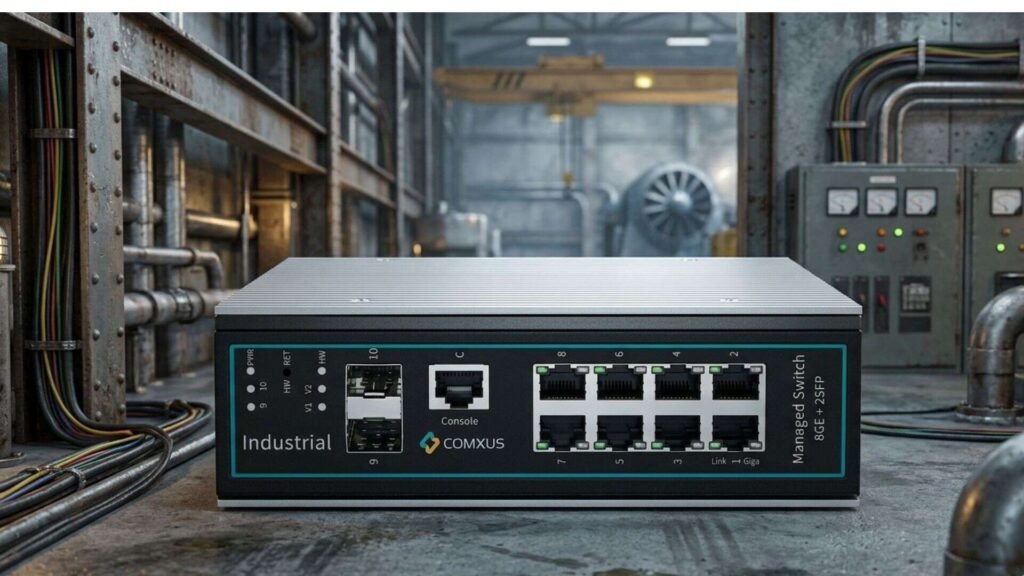
They come with higher backplane capacity and faster packet processing. This allows multiple devices to communicate without delay. They are widely used in data-intensive industrial applications.
Why Bandwidth Matters in Industrial Networks?
Bandwidth defines how much data can travel through a network. In industrial environments, data includes control signals, video feeds, and sensor data.
If bandwidth is low, data congestion occurs. This leads to delays and packet loss. I have seen this impact real-time automation systems.
High bandwidth ensures smooth and uninterrupted communication. It improves system responsiveness and efficiency.
List of industrial switches offering high bandwidth
All Comxus industrial switches are designed to deliver high-bandwidth performance for demanding network environments. Below are some of the most preferred models, widely selected by our clients for CCTV surveillance applications.
| Product Name | Model Number | Bandwidth |
| Comxus 4 port managed industrial grade PoE switch with 2 sfp ports | CX-NPA-4GS2I-L2 | 12Gbps |
| Comxus 8 port managed industrial ethernet PoE switch with 2 sfp ports | CX-NPA-8GS2I-L2 | 20Gbps |
| Comxus 8 port managed industrial ethernet PoE switch with 4 sfp ports | CX-NPA-8GS4I-L2 | 24Gbps |
| Comxus 16 port managed industrial ethernet PoE switch with 2 sfp ports | CX-NPA-16GS2I-L2 | 36Gbps |
What is the Role of High Bandwidth Switches in Industrial Automation?
Industrial automation requires real-time communication. PLCs, HMIs, and SCADA systems depend on fast data exchange.
High bandwidth switches reduce latency and improve data flow. They ensure that critical control data reaches on time.
They also support multiple devices without performance issues. This is important in large industrial networks.
These switches are often used in backbone connectivity. They connect different parts of the network efficiently.
Supporting Industrial IoT and Smart Factories:
Industrial IoT generates a large amount of data. Sensors, cameras, and analytics systems continuously transmit information.
High bandwidth switches handle this data efficiently. They support edge computing and cloud integration.
In smart factories, real-time data analysis is important. High bandwidth ensures faster processing and decision-making.
This improves productivity and operational efficiency.
Impact on Network Performance and Reliability:
Network performance depends on bandwidth and design. High bandwidth switches reduce network congestion.
They allow smooth data transmission even during peak load. This improves overall system reliability.
They also support advanced features like QoS. This ensures that critical traffic gets priority.
I always recommend high bandwidth switches for critical applications.
Benefits of Using High Bandwidth Industrial Switches
High bandwidth switches improve network efficiency. They reduce delays and prevent data loss.
They support scalability and future expansion. This is important in growing industrial networks.
They also enhance system reliability and performance. This reduces downtime and maintenance costs.
Overall, they provide a strong foundation for modern industrial networking.
Conclusion-
High bandwidth industrial switches are essential for modern automation systems. They ensure fast, reliable, and scalable communication.
From my experience, investing in high bandwidth infrastructure is always beneficial. It supports current needs and future growth.
In today’s data-driven industrial world, high bandwidth is not optional. It is a necessity for efficient operations.
