
Choosing between an 8 port and a 16 port industrial PoE switch is a common challenge. I have seen many engineers struggle with this decision. The right choice depends on your network size, power needs, and future plans.
In industrial automation, PoE switches power and connect multiple devices. These include IP cameras, wireless access points, and HMI panels. A wrong selection can lead to network congestion or wasted investment.
In this guide, I will help you understand which option fits your application better.
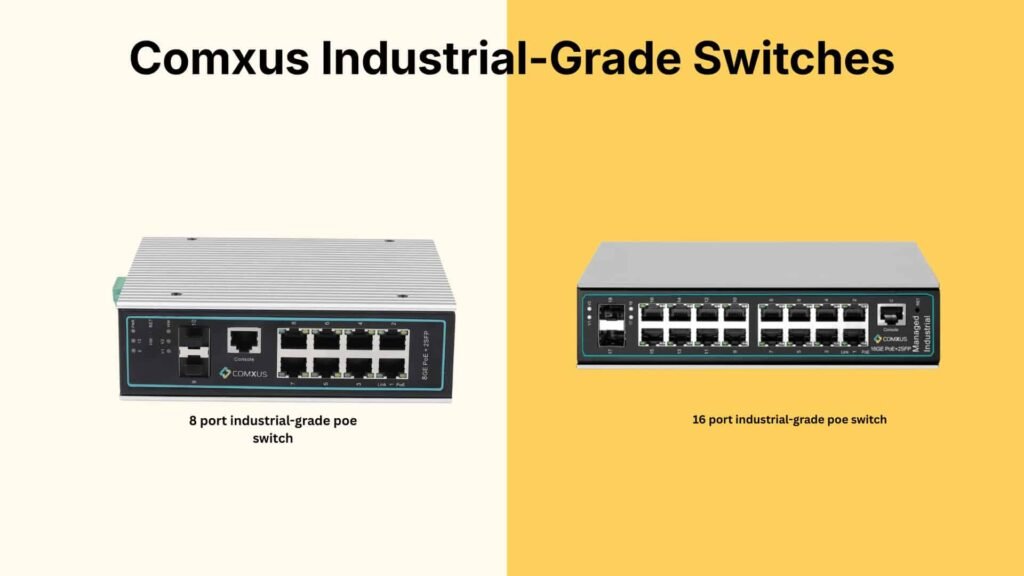
What is an 8 Port Industrial PoE Switch?
An 8 port industrial PoE switch provides eight Ethernet ports with power delivery. It is designed for small to medium industrial networks.
I usually recommend this switch for compact setups. It works well in machine-level automation and small control panels.
These switches are cost-effective and easy to deploy. They consume less power and require minimal space.
They are ideal when you have limited devices. They also simplify cable management inside enclosures.
What is a 16 Port Industrial PoE Switch?
A 16 port industrial PoE switch offers sixteen Ethernet ports with PoE capability. It is suitable for larger and more complex networks.
I often use these switches in plant-wide deployments. They support more devices and reduce the need for multiple switches.
These switches are designed for scalability. They handle higher traffic and support advanced networking features.
They are commonly used in surveillance systems and large automation setups.
What are the core differences between 8 ports and 16 port PoE Switches?
Here is a quick comparison to help you understand the differences clearly.
| Feature | 8 Port PoE Switch | 16 Port PoE Switch |
| Number of Ports | 8 Ports | 16 Ports |
| Network Size | Small networks | Medium to large networks |
| Power Budget | Lower PoE capacity | Higher PoE capacity |
| Space Requirement | Compact size | Larger footprint |
| Cost | Lower initial cost | Higher initial cost |
An 8 port switch is simple and efficient. A 16 port switch offers better scalability and expansion.
When Should You Choose an 8 Port PoE Switch?
I recommend an 8 port switch when your network is small and stable. It works best when you know the exact number of devices.
Typical use cases include:
- Small PLC-based automation systems
- Individual machines or production units
- Limited IP camera installations
- Compact control panels
These switches are easy to install and maintain. They also reduce unnecessary investment.
If your network does not require expansion, an 8 port switch is a smart choice.
When Should You Choose a 16 Port PoE Switch?
A 16 port switch is ideal when your network is growing. I prefer it for applications where scalability is important.
Typical use cases include:
- Large industrial plants
- Centralized surveillance systems
- Smart factory and IIoT deployments
- Backbone connectivity in automation networks
These switches support more devices without adding extra hardware. This reduces network complexity.
They also handle higher traffic loads efficiently. This improves overall network performance.
PoE Power Considerations
Power budget is a critical factor in both options. I always calculate total device power before selecting a switch.
An 8 port switch usually offers a lower PoE budget. It is suitable for low-power devices.
A 16 port switch provides a higher total power budget. It supports multiple high-power devices like PTZ cameras.
Always check IEEE standards like 802.3af and 802.3at. This ensures compatibility with connected devices.
Network Performance and Scalability
Network performance depends on traffic load and design. An 8 port switch performs well in low-traffic environments.
However, it can become a bottleneck in growing networks. This is where a 16 port switch offers an advantage.
A 16 port switch reduces the need for multiple switches. This improves network efficiency and reduces latency.
It also supports better scalability. You can add new devices without redesigning the network.
Space and Installation Considerations
In industrial environments, space is often limited. I have seen many control panels with strict space constraints.
An 8 port switch is compact and fits easily in small enclosures. It is ideal for DIN rail mounting.
A 16 port switch requires more space. It may need better ventilation and panel planning.
Always evaluate your panel design before selecting the switch.
Cost vs Long-Term Value
Cost is an important factor, but it should not be the only one. An 8 port switch has a lower initial cost.
However, adding more switches later can increase overall expense. It can also make the network more complex.
A 16 port switch requires higher investment upfront. But it offers better long-term value and scalability.
I usually recommend thinking about future expansion before making a decision.
Conclusion-
Both 8 port and 16 port industrial PoE switches have their own advantages. The right choice depends on your application and network design.
An 8 port switch is suitable for small and stable networks. It is cost-effective and easy to deploy.
A 16 port switch is better for larger and growing networks. It offers scalability, higher power capacity, and better performance.
From my experience, always plan for future expansion. Choosing the right switch today can save cost and effort later.
