
In today’s fast-evolving industrial landscape, automation and data exchange play a crucial role in improving efficiency, safety, and productivity. This is where Industrial Communication Protocols come into the picture. They act as the backbone of modern industrial systems, enabling different machines, devices, and control systems to communicate seamlessly with each other.
What are Industrial Communication Protocols?
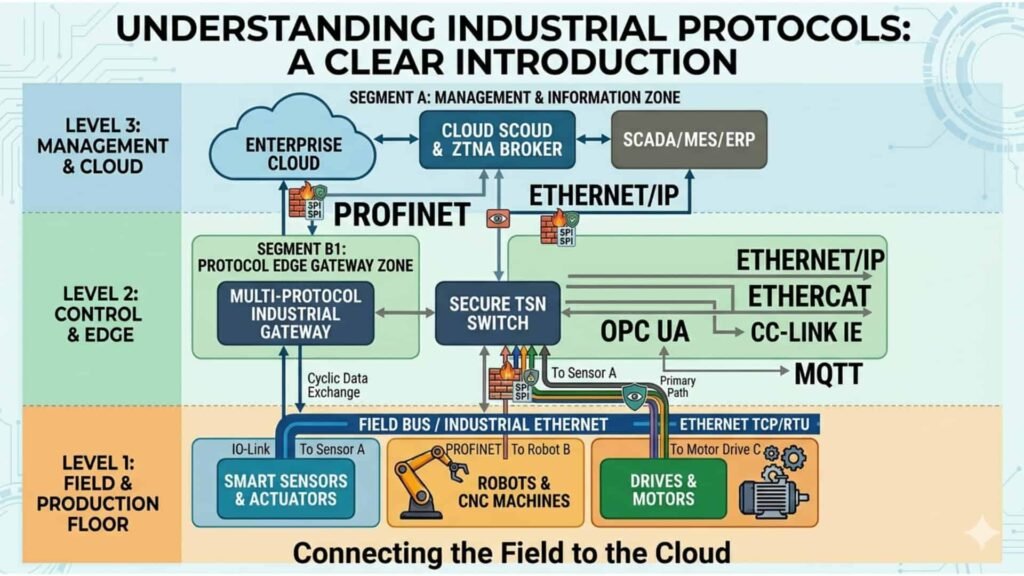
Industrial communication protocols are a set of rules or standards that allow devices such as PLCs (Programmable Logic Controllers), sensors, actuators, and SCADA systems to exchange data in a structured and reliable manner. These protocols ensure that information is transmitted accurately and efficiently across industrial networks.
Without these protocols, machines from different manufacturers would not be able to “talk” to each other, leading to inefficiencies and system failures.
Why are They Important?
Industrial communication protocols are essential for:
- Real-time monitoring and control
- Improved system integration
- Reduced downtime and maintenance costs
- Enhanced safety and reliability
- Better data collection for decision-making
They help industries move towards smarter manufacturing, often referred to as Industry 4.0.
Types of Industrial Communication Protocols
There are several types of protocols used in industrial automation, each designed for specific applications:
1. Fieldbus Protocols
These are used for communication between field devices like sensors and controllers. Examples include Modbus, PROFIBUS, and CAN bus.
2. Ethernet-Based Protocols
With the rise of Industrial IoT, Ethernet-based protocols have become more popular due to their speed and scalability. Common examples include:
- Ethernet/IP
- PROFINET
- EtherCAT
3. Wireless Protocols
Wireless communication is increasingly used in industries for flexibility and remote monitoring. Examples include Wi-Fi, Zigbee, and Bluetooth-based industrial solutions.
Key Features of Industrial Protocols
Some important features that define a good industrial communication protocol include:
- Reliability: Ensures data reaches its destination without errors
- Determinism: Guarantees data delivery within a fixed time
- Scalability: Supports network expansion
- Interoperability: Allows devices from different manufacturers to work together
- Security: Protects systems from cyber threats
Some widely used industrial communication protocols include:
- Modbus: Simple and widely adopted protocol for serial communication
- PROFIBUS: Popular in manufacturing automation
- Ethernet/IP: Used for high-speed industrial Ethernet communication
- OPC UA: A modern, platform-independent protocol for secure data exchange
Applications in Industry
Industrial communication protocols are used across various sectors, such as:
- Manufacturing and production lines
- Oil and gas industries
- Power plants and energy systems
- Fire safety and alarm systems
- Building automation systems
They enable centralized control and monitoring, improving operational efficiency.
Challenges in Industrial Communication
Despite their advantages, there are some challenges:
- Compatibility issues between different protocols
- Cybersecurity risks
- High initial setup cost
- Complexity in configuration and maintenance
However, with advancements in technology, many of these challenges are being addressed.
Industrial communication protocols are the foundation of modern automation systems. They enable seamless communication between devices, improve efficiency, and support the transition towards smart industries. As technologies like IoT and AI continue to grow, these protocols will become even more important in shaping the future of industrial automation.
Understanding these protocols is essential for anyone involved in industrial systems, whether you are an engineer, technician, or business owner looking to optimize operations.
