
Industrial automation depends on fast and reliable communication. Ethernet switches play a central role in this communication. They connect controllers, sensors, HMIs, and servers into a unified network.
In modern plants, every process depends on real-time data exchange. A well-designed switching infrastructure ensures smooth and uninterrupted operations.
This article explains the role of Ethernet switches in industrial automation with practical insights.
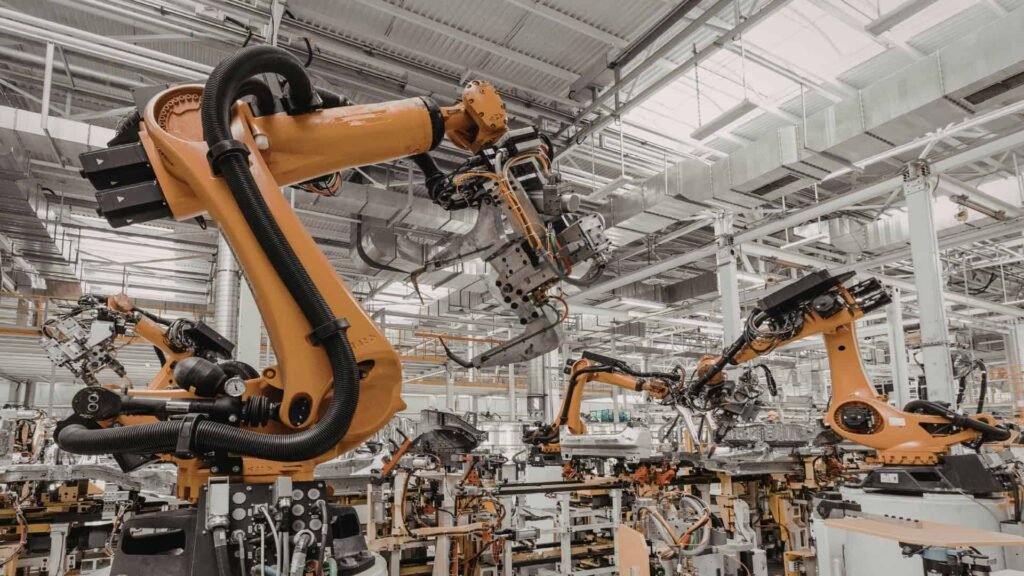
What Is an Industrial Ethernet Switch?
An industrial Ethernet switch is a networking device designed for harsh environments. It connects multiple devices within an industrial network.
Unlike commercial switches, these devices handle extreme temperatures, vibration, and electrical noise. They also support industrial communication protocols.
Industrial switches are available in managed and unmanaged variants. Managed switches provide better control and visibility.
Role of Industrial-grade switches in industrial automation:
1. Enabling Real-Time Communication
Industrial automation requires deterministic communication. Data must reach devices within a defined time.
Ethernet switches support this requirement through traffic prioritization. Quality of Service ensures critical data gets higher priority.
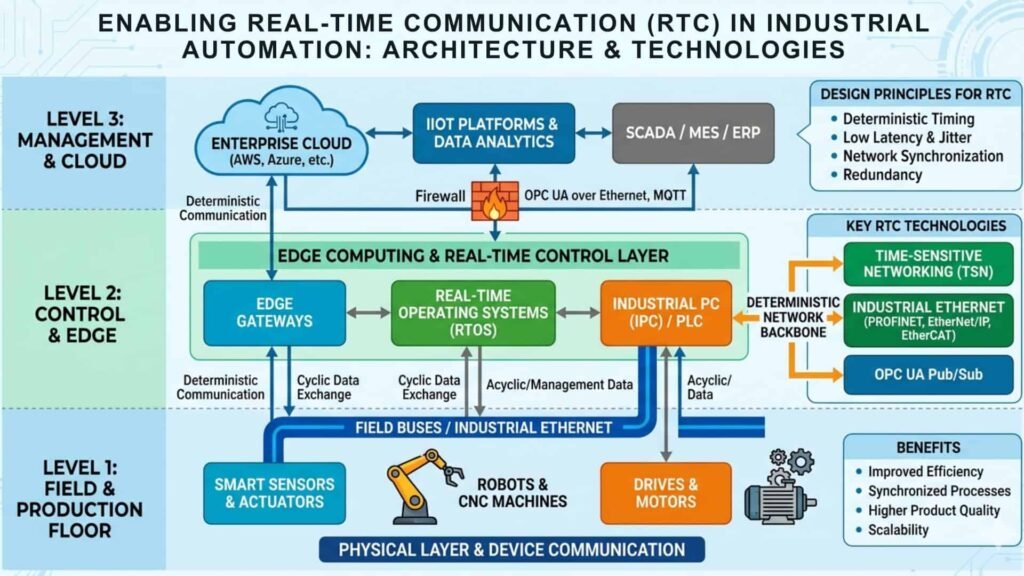
Protocols like PROFINET and EtherNet/IP depend on low latency. Switches optimize packet forwarding to meet these demands.
Cut-through switching and low jitter improve real-time performance. This is critical in motion control and process automation.
2. Network Segmentation and Traffic Control
Industrial networks carry different types of traffic. Control data, video streams, and enterprise traffic share the same network.
Ethernet switches enable network segmentation using VLANs. This isolates traffic and improves performance.
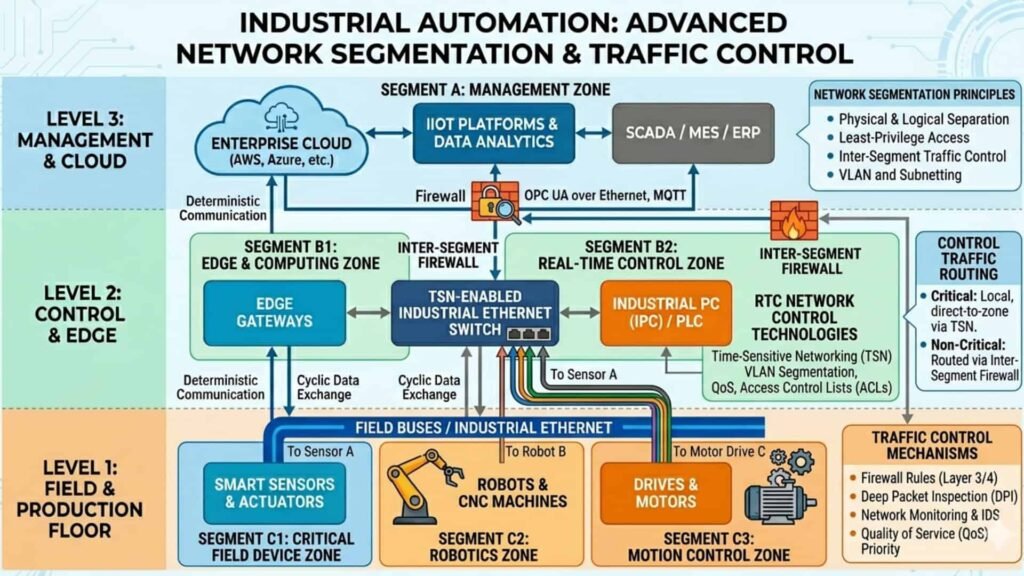
Traffic control features include:
- VLAN configuration for logical segmentation
- QoS for prioritizing critical packets
- Broadcast storm control to prevent network overload
Segmentation enhances both performance and security.
3. Supporting Industrial Protocols
Industrial automation relies on specialized communication protocols. Ethernet switches must support these protocols efficiently.
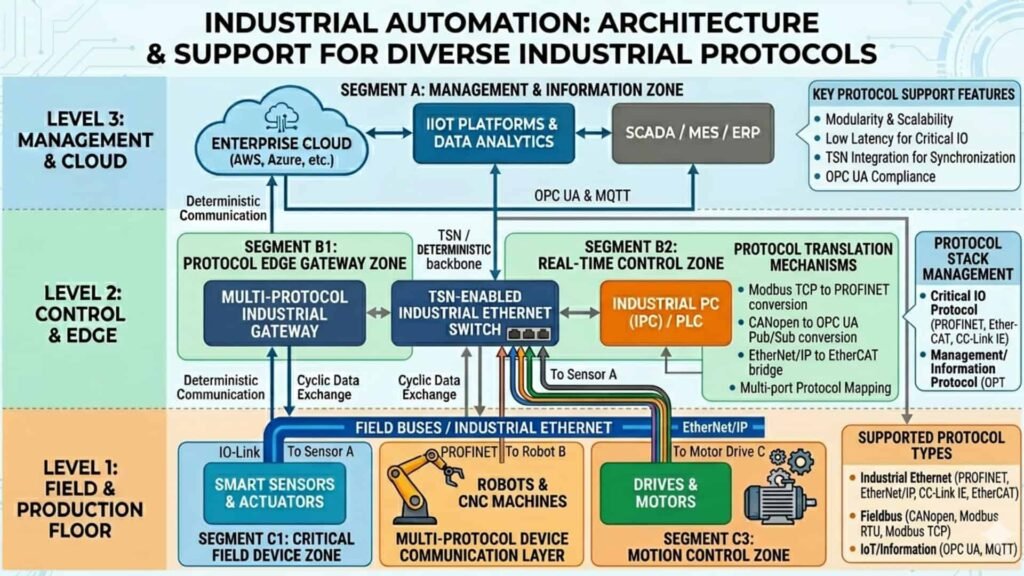
Common protocols include:
- PROFINET for real-time automation
- EtherNet/IP for industrial control systems
- Modbus TCP for legacy integration
Managed switches can inspect and prioritize protocol traffic. This ensures stable communication across the network.
Protocol awareness is important for troubleshooting and diagnostics.
4. Ensuring Network Redundancy and High Availability
Downtime in industrial environments leads to production loss. Ethernet switches provide redundancy to ensure continuous operation.
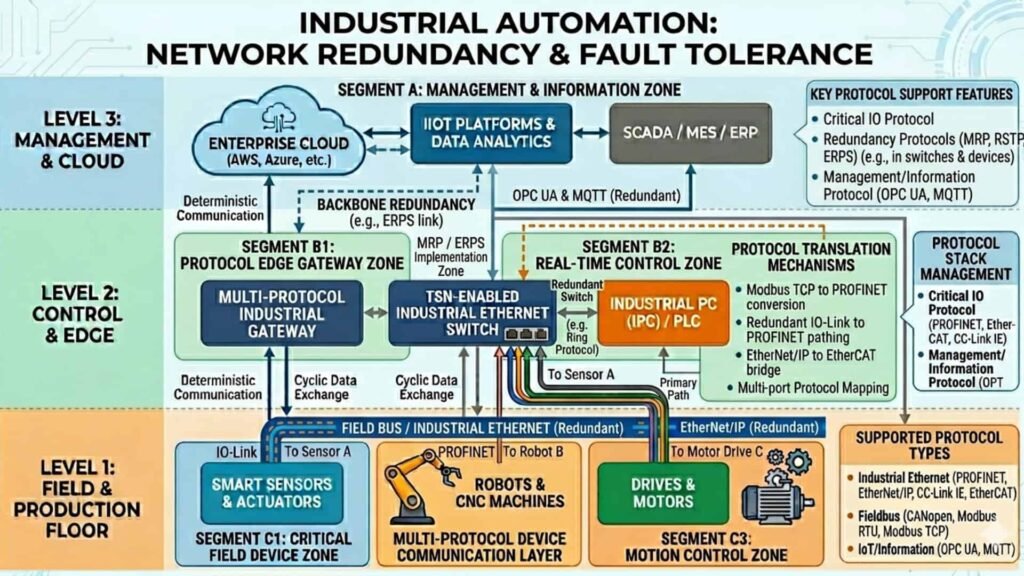
Common redundancy mechanisms include:
- Rapid Spanning Tree Protocol (RSTP)
- Media Redundancy Protocol (MRP)
- Ethernet Ring Protection Switching (ERPS)
These protocols provide fast recovery during link failure. Recovery time can be in milliseconds.
Redundant topologies like ring and mesh improve network resilience.
5. Enhancing Network Security
Industrial networks are increasingly exposed to cyber threats. Ethernet switches help in securing the network.
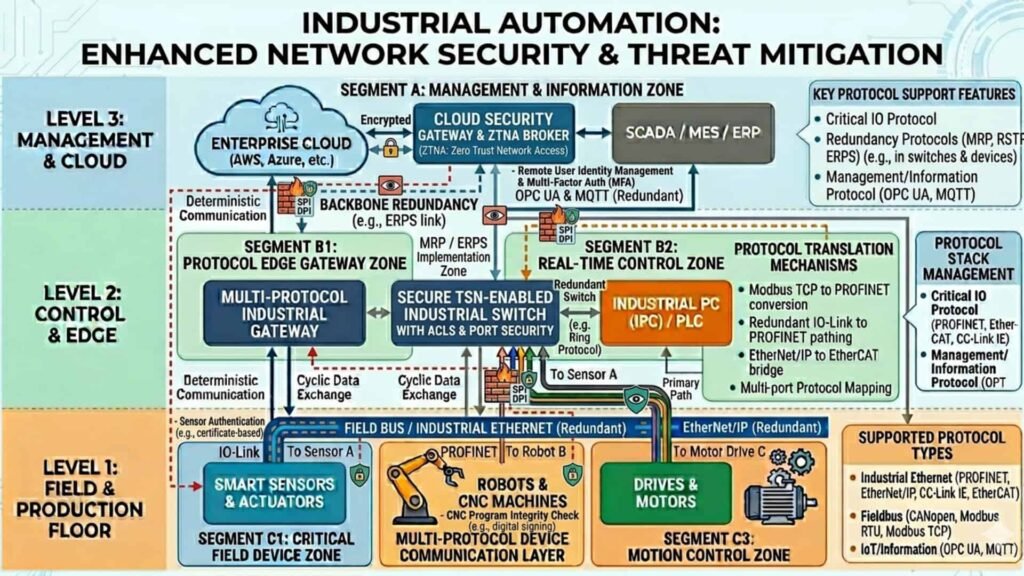
Managed switches offer security features such as:
- Access Control Lists for traffic filtering
- Port security to restrict unauthorized devices
- DHCP snooping to prevent spoofing attacks
Switch-level security adds an important defense layer. It complements firewalls and other security systems.
Segmentation also reduces the attack surface.
6. Simplifying Network Management and Monitoring
Visibility is critical in industrial networks. Ethernet switches provide tools for monitoring and management.
Features include:
- SNMP for network monitoring
- Port mirroring for traffic analysis
- Syslog for event logging
Engineers can detect faults and performance issues quickly. This reduces downtime and improves maintenance efficiency.
Advanced switches support web interfaces and centralized management systems.
7. Supporting Industrial IoT and Edge Computing
Industrial automation is evolving with IIoT integration. Ethernet switches act as a bridge between field devices and cloud systems.
They connect edge gateways, sensors, and controllers. This enables data collection and analytics.
High bandwidth and low latency are essential for IIoT applications. Gigabit and 10 Gigabit switches support these requirements.
Switches also support Power over Ethernet. This simplifies deployment of IP cameras and wireless access points.
8. Operating in Harsh Industrial Environments
Industrial switches are built for tough conditions. They operate reliably in extreme environments.
Key features include:
- Wide temperature range operation
- Vibration and shock
- Electromagnetic interference protection
- IP-rated metal enclosures
These features ensure long-term performance in factories, oil and gas sites, and outdoor installations.
DIN rail mounting allows easy installation in control panels.
9. Role in Scalable Network Design
Industrial networks grow over time. Ethernet switches support scalability and modular expansion.
Stackable and modular switches allow easy network expansion. Engineers can add new devices without redesigning the network.
Layer 2 and Layer 3 capabilities enable efficient routing and segmentation.
Future-ready switches support IPv6 and advanced routing protocols.
Ethernet switches are the backbone of industrial automation networks. They enable reliable communication, security, and scalability.
From real-time data transfer to network redundancy, their role is critical. A well-chosen switch improves system performance and uptime.
For engineers and system integrators, selecting the right switch is essential. It ensures smooth operation and future readiness.
As industrial systems become more connected, the importance of Ethernet switches will continue to grow.
