
SFP ports are essential components in modern industrial networking. They provide flexible and high-speed connectivity for industrial switches. If you work with industrial Ethernet, you will often see SFP ports used for fiber connections.
SFP stands for Small Form-factor Pluggable. It is a compact and hot-swappable interface used for network communication. These ports allow switches to connect using fiber optic or copper modules.
In simple terms, SFP ports give you flexibility. You can choose the type of connection based on your network requirement. This makes them highly useful in industrial environments.
How Does SFP Port Work in Industrial Switch?
SFP ports do not work alone. They require an SFP module, also called a transceiver. This module is inserted into the SFP slot of the switch.
Once inserted, the module converts electrical signals into optical signals. This allows data transmission over fiber optic cables. If you use copper SFP modules, they support Ethernet over twisted pair cables.
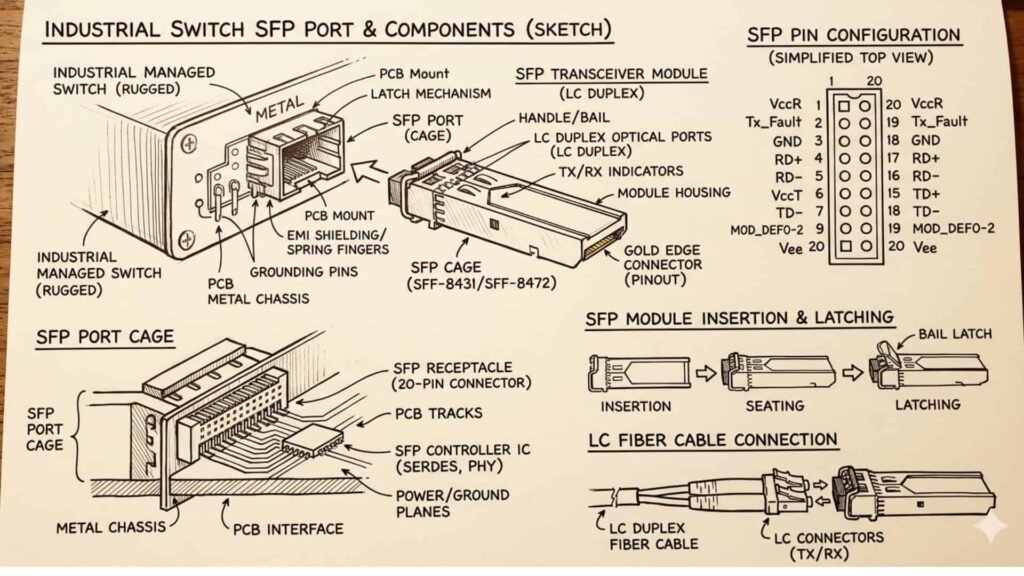
The hot-swappable design is very useful. You can replace or upgrade modules without shutting down the switch. This reduces downtime in critical industrial operations.
How Many types of SFP Modules Used in Industrial Networking?
SFP ports support different types of modules based on distance and application. Choosing the right module is important for network performance.
Common types include:
- Single-mode SFP modules for long-distance communication
- Multi-mode SFP modules for short-distance applications
- Copper SFP modules for standard Ethernet connections
Single-mode fiber can transmit data over several kilometers. Multi-mode fiber is suitable for shorter distances within plants.
These options make SFP ports highly adaptable. They support various industrial networking scenarios.
Why Are SFP Ports Important in Industrial Switches?
Industrial networks often operate in harsh and complex environments. Standard Ethernet ports may not always be sufficient.
SFP ports provide long-distance connectivity using fiber optics. This is important in large industrial plants or outdoor installations.
They also offer immunity to electromagnetic interference. This makes them ideal for environments with heavy machinery.
Another advantage is scalability. You can upgrade network speed or distance by changing the SFP module.
What are the key benefits of using SFP ports?
SFP ports offer several advantages in industrial networking. These benefits improve both performance and flexibility.
- High-speed data transmission
- Support for long-distance communication
- Reduced signal loss and interference
- Flexible network design
- Easy upgrade and replacement
These features make SFP ports a preferred choice for modern industrial networks.
What is the difference between SFP ports and RJ45 ports in industrial switches?
Many engineers compare SFP ports with RJ45 Ethernet ports. Both serve different purposes in a network.
RJ45 ports are used for short-distance connections. They are common in office and small industrial setups.
SFP ports are used for longer distances and high-performance requirements. They support fiber optic cables, which offer better reliability.
In most industrial switches, both ports are available. This allows a hybrid network design.
Where Are SFP Ports Used in Industrial Applications?
SFP ports are widely used across different industrial sectors. They play a key role in building reliable communication networks.
Common applications include:
- Manufacturing plants with large network coverage
- Oil and gas facilities with remote monitoring systems
- Power substations requiring high reliability
- Railway and transportation systems
- Smart city and surveillance networks
In these environments, long-distance and stable communication is critical. SFP ports help achieve that.
SFP Ports and Industrial Network Design
When designing an industrial network, flexibility is very important. SFP ports allow engineers to design scalable and future-ready networks.
You can start with a basic setup and expand later. Just replace the SFP module to increase distance or speed.
They also support ring and redundant network topologies. This improves network availability and reduces downtime.
Industrial switches with SFP ports are often used in backbone connectivity. They connect different network segments efficiently.
Common Mistakes to Avoid While Using SFP Ports
Many users face issues due to incorrect SFP selection. It is important to choose compatible modules.
Always check the switch compatibility list. Not all SFP modules work with every switch.
Use the correct fiber type. Mixing single-mode and multi-mode can cause communication failure.
Also, consider distance and wavelength requirements. This ensures stable and reliable performance.
Conclusion
SFP ports in industrial switches provide flexibility, scalability, and high performance. They are essential for modern industrial networking.
They allow long-distance communication using fiber optics. They also reduce interference and improve network reliability.
For network engineers and system integrators, understanding SFP ports is very important. It helps in designing efficient and future-ready networks.
As industrial networks grow, the role of SFP ports will become even more critical.
