
The Traffic You Cannot See Inside a Data Centre
Imagine a customer opening your company’s online ordering application on a Monday morning. She searches for a product, adds it to her basket and pays. To her, it feels like one smooth action on one screen.
Inside your data centre, much more is happening. The application server asks a database server for product details. Another system checks stock, a pricing service calculates the total, and storage infrastructure supplies the records behind each step. One click can trigger dozens of short conversations between machines she will never see.
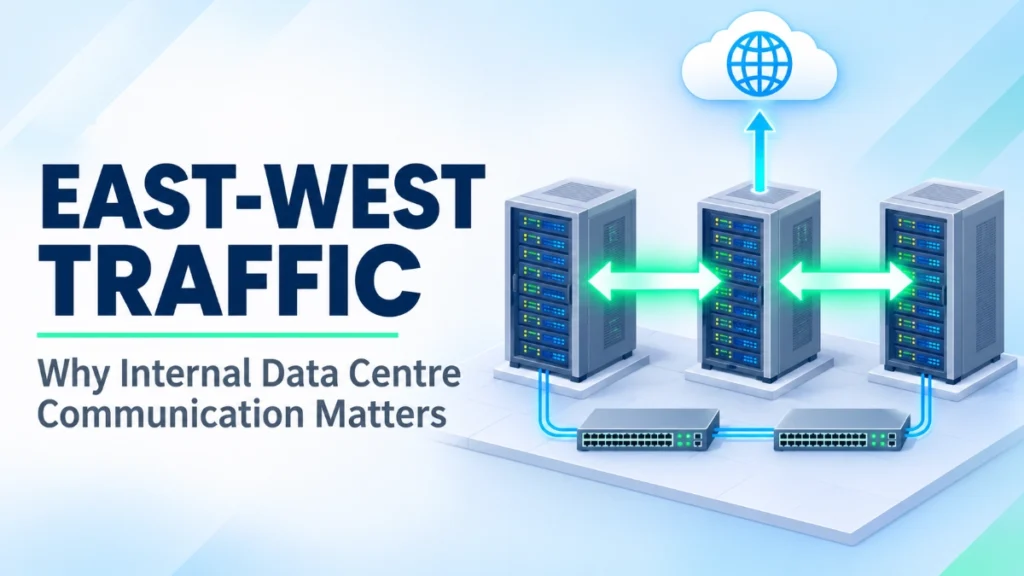
A data centre handles two kinds of communication: traffic between its own internal systems, and traffic between the facility and the outside world. Teams often watch the second kind closely because users and internet links make it visible. The first kind is easier to overlook, yet it can place heavy demand on the network. This internal, server-to-server communication is called east-west traffic.
Understanding east-west traffic in data centres helps you plan capacity, avoid slow applications and build a network that grows with your business. This guide explains it in plain language.
What Is East-West Traffic in Data Centres?
East-west traffic in data centres is the data that moves between resources inside the data centre, such as servers, storage systems, virtual machines and containers. In simple terms, it is internal server-to-server communication.
Think of a data centre as a busy office. When a customer places an order, the sales team talks to the warehouse, the warehouse talks to accounts, and accounts talk to delivery. The customer never hears those conversations, yet the order cannot finish without them. East-west traffic is the network version of that internal teamwork.
A typical example starts with an application server that receives a request and queries a database server. The database may read from a storage system, and the answer travels back across the same internal network. Similar exchanges happen between virtual machines on different hosts, between containers in a cluster, and between systems that replicate data for resilience.
The name comes from network diagrams, where internal links are often drawn horizontally. East-west is a conceptual label, not a physical rule. This traffic may cross several switches, network segments or virtualised environments, and where “inside” ends depends on how the network is designed.
What Is the Difference Between East-West and North-South Traffic?
Both terms describe the direction of communication relative to the data centre boundary.
- East-west traffic flows between internal resources. Examples include server-to-server exchanges, application-to-database queries and server-to-storage access. It is often described as lateral data movement.
- North-south traffic enters or leaves the data centre. Examples include users reaching an application, external API requests, internet traffic and communication with outside services.
| Factor | East-West Traffic | North-South Traffic |
|---|---|---|
| Direction | Between internal resources | Between internal and external networks |
| Typical communication | Server to server | User to application |
| Common example | Application server to database | Customer accessing a website |
| Network considerations | Internal bandwidth, latency, congestion | External connectivity, security, ingress and egress |
A single customer action usually involves both. When the browser reaches your application, that is north-south traffic. When the application then calls the database, that is east-west traffic.
These are conceptual patterns, and actual paths depend on network design, routing, virtualisation and deployment architecture. Two virtual machines on the same host may exchange data without leaving that host, while the same pair on different hosts will cross physical switches. Load balancers, firewalls and gateways can also blur where one pattern ends, and the other begins.
Neither pattern is always larger. The balance depends on the workload.
Why Is East-West Traffic Increasing in Modern Data Centres?
Modern applications are built from many cooperating parts rather than one large program. That design choice creates more internal conversations.
- Virtualisation: Many workloads share physical servers, and a virtual machine may sit on a different host from the systems it depends on.
- Microservices and containers: Cloud-native applications split functions into small services that call one another over the network.
- Database and application queries: Front-end systems, business logic and databases exchange data constantly.
- Replication and synchronisation: Copies of data move between servers to support availability and consistency.
- Storage access and backups: Servers read from and write to storage systems, and backup jobs move large volumes of data.
- AI and high-performance computing: Where these workloads run, many servers may exchange data while working on the same task.
Consider a customer checking an order status. The web tier calls an order service. That service asks an inventory service, a customer-profile service and a database. Every internal call is east-west traffic, even though the customer sent a single request.
The volume and pattern of east-west traffic depend on the workload and architecture. A small facility running a few traditional applications may see modest internal traffic, while a large container platform may generate far more. Measure your own environment instead of assuming.
Why Does East-West Traffic Matter for Data Centre Performance?
Internal communication shapes how fast and how reliably applications respond. Five areas deserve attention.
1. Network bandwidth: Bandwidth is the maximum capacity of a link. When many servers exchange data at the same time, they compete for internal links. Throughput, the data rate actually achieved, can fall below bandwidth when links are busy or conditions are poor.
2. Latency: Latency is the time data takes to travel from one point to another. An application that makes hundreds of small internal calls per request feels every extra millisecond multiplied many times.
3. Congestion: When traffic exceeds the capacity of a link or the forwarding capacity of a switch, queues build up. Delays grow, and packets may eventually be dropped. Packet loss forces retransmissions, which add further delay.
4. Application performance: Distributed applications depend on several components responding quickly. A slow database call, a slow storage read or a delayed network exchange can each affect what the user sees. End-to-end performance reflects application, server, storage and network delays together, so the network is not always the culprit.
5. Scalability: As you add servers, virtual machines and applications, the number of internal conversations grows, and patterns become harder to predict. A network that works well for ten servers may need rethinking for a hundred.
These effects depend on the environment. Plenty of data centres carry heavy east-west traffic without problems because their networks are designed for it.
How Does Network Architecture Handle East-West Traffic?
The way you connect switches decides how internal traffic travels and how much capacity is available along the way.
Traditional Three-Tier Architecture
The classic design has three layers. Access switches connect servers, aggregation switches combine access switches, and core switches link the aggregation layer and the wider network. This design suits environments where most traffic flows in and out of the data centre.
When two servers sit under different access switches, their traffic may climb through aggregation and sometimes core layers before coming back down. That path is longer and may share links with other traffic.
Oversubscription matters here. It means the combined capacity of downstream ports exceeds the uplink capacity above them. Oversubscription is a deliberate design choice, not necessarily a fault, and many networks run well with it. The question is whether the ratio fits the workload. A well-planned three-tier network is not automatically a bottleneck.
Spine-Leaf Architecture
In spine-leaf architecture, leaf switches connect to servers and spine switches connect the leaf switches to one another. Each leaf typically links to multiple spines.
A simple conceptual path looks like this:
Server A → Leaf Switch 1 → Spine Switch → Leaf Switch 2 → Server B
Because traffic between any two leaves usually crosses the same number of hops, paths are predictable. Multiple links and spines provide several routes, which supports scalable east-west communication. Capacity grows by adding leaves or spines.
The actual path depends on routing, topology and configuration. Spine-leaf does not automatically remove congestion or latency, and it is not right for every environment. Smaller or traffic-light sites may be well served by simpler designs.
Common Challenges Caused by Heavy East-West Traffic
When internal traffic grows faster than the network was planned for, several problems can appear:
- Congestion and oversubscribed links: Busy uplinks create queues and delay.
- High latency between servers: Extra hops, queuing and busy links slow each exchange.
- Packet drops and retransmissions: Lost packets must be sent again, which lowers effective throughput.
- Uneven traffic distribution: Some links stay busy while others sit idle, often because traffic is not balanced across available paths.
- Switch buffer and queue management challenges: Short bursts can overflow buffers if they are not sized or managed for the traffic pattern.
- Insufficient link capacity: Server speeds may outgrow uplinks.
- Limited visibility: Teams that monitor only the internet edge may not see internal hot spots.
These issues can show up as slow application responses, delayed database queries, slower storage access and longer backup or replication windows.
High east-west traffic does not automatically mean poor performance. Problems arise when network capacity, architecture or traffic management cannot support the workload.
How Can Organisations Optimise East-West Traffic?
Start with evidence, then change the design only where needed.
1. Understand internal traffic patterns: Monitor which servers talk to one another and how much. Identify high-volume connections and frequently used paths. You cannot size a network for traffic you have never measured.
2. Design for expected workloads: Include east-west traffic when planning capacity. Review architecture, link speeds and oversubscription ratios against real demand. Faster links alone do not fix every problem, because delays can also come from applications, servers, storage or configuration.
3. Use suitable switching infrastructure: Switch capacity, port density, forwarding performance and uplink bandwidth all influence internal communication. Match them to the workload rather than to a generic specification. Reliable Ethernet switching and adequate uplinks matter in any network. Comxus, as an industrial networking OEM, sees the same fundamentals of capacity, latency and scalable design apply across Ethernet environments.
4. Monitor congestion and latency: Review interface utilisation, queue statistics, packet drops and latency. Use monitoring and troubleshooting tools to find issues early, and compare trends over time instead of single readings.
5. Consider network segmentation: Separating workloads can improve security, management and operations. Plan it carefully so required application communication is not restricted, and so segmentation does not force traffic through unnecessary detours.
6. Plan for future growth: Allow for more servers, storage, virtual machines and applications. Designing only for today’s traffic usually leads to early upgrades.
Test changes before applying them and follow your change-management procedures. Disruptive changes on a live network without testing can create more problems than they solve.
East-West Traffic and the Future of Data Centre Networking
Workloads keep changing, and internal network requirements change with them. Distributed applications spread work across more components. Hybrid and cloud-connected infrastructure adds communication between on-premises systems and cloud services. AI and high-performance computing can involve many servers exchanging data while they work together. Servers and storage also communicate more as data volumes grow.
The common thread is not a single technology but a need for networks that are scalable, observable and well-designed. Organisations that understand how their systems talk to each other are better placed to adapt, whichever workloads they adopt.
Conclusion: Why Internal Network Traffic Deserves Attention
East-west traffic in data centres is the constant conversation between servers, storage and applications behind every user request. It is easy to miss, but it influences bandwidth use, latency, congestion and how well a network scales.
Capacity, architecture and visibility work together. A good design with poor monitoring can hide problems, and fast links with a poor design can still disappoint.
The practical takeaway: measure which systems communicate and how much, then use that evidence when you plan or upgrade your network.
Read Also: Data Centre Network Security: Key Risks and Protection Strategies
Read Also: What Is Congestion Control in High-Performance Data Centre Networks?
