
Network engineers often focus on switches, routing, and bandwidth But the real behavior of a network begins with its topology. Topology decides how devices communicate. It also decides how networks fail. One interesting design is ring topology. It is simple in structure but powerful in certain environments.
Many engineers assume ring topology is outdated. That assumption is not always correct. Industrial networks still rely on ring designs. Certain enterprise systems also use it for redundancy. Understanding ring topology helps engineers design stable networks.
It also helps during troubleshooting and system upgrades. Let us explore how it works.
What Is Ring Topology?
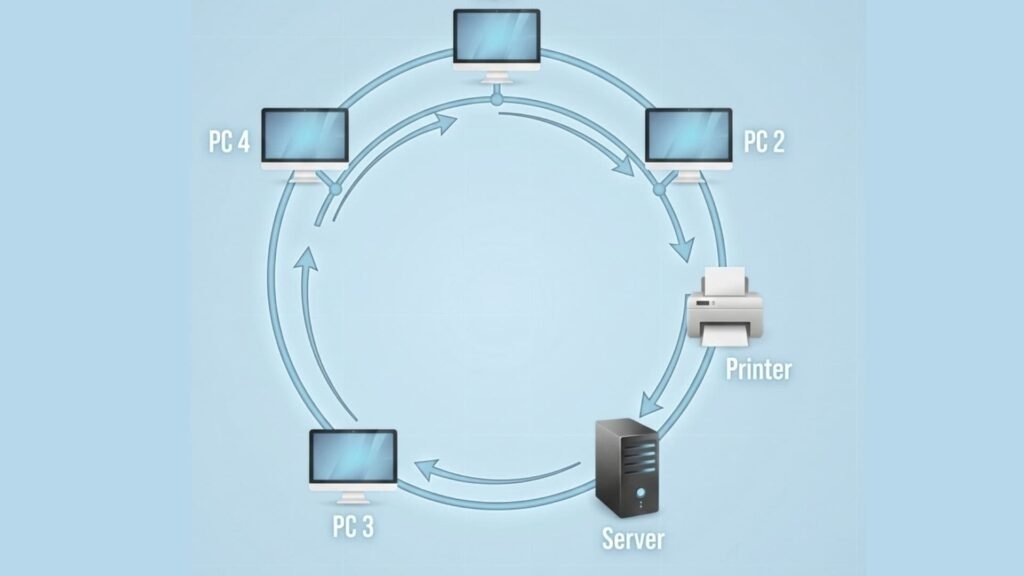
Ring topology is a network structure where devices connect in a loop. Each device links to two neighboring devices. The first device connects to the last device.
This network topology creates a closed circular path. Data travels from one node to the next. Each device passes the data along the ring.
The data continues until it reaches its destination. After that, the frame may return to the sender. Unlike star topology, there is no central switch.
The network depends on every device in the ring. This structure forms a continuous communication path.
How Does It Work?
In a ring topology, devices communicate using a controlled process. Data does not move randomly across the network. Instead, frames travel in a fixed direction. Each node acts as a repeater.
The device receives a frame first, Then it checks the destination address.
If the frame is not intended for that device, it forwards it. The process repeats across the network.
Some ring networks use token passing. Only the device holding the token can transmit data.
This prevents collisions completely. It also creates predictable network behavior.
Deterministic communication becomes possible. That is why industrial networks prefer ring designs.
What Are The Key Components Of Ring Topology?
Several components form a functional ring network.
Network nodes :
These include computers, switches, and industrial controllers.
Each node connects to two other devices.
Network interface connections:
Each device needs two interfaces.One interface receives data. The other forwards it.
Transmission medium
Ethernet cables or fiber links are common. Industrial networks often prefer fiber.
Ring management protocols
Protocols control data flow and redundancy. Examples include Media Redundancy Protocol.
These elements keep the ring stable. Without proper configuration, the ring can fail quickly.
What Are The Types Of Ring Topology?
Generally, There are two types of ring topology:
Single Ring Topology:
This is the simplest form. Devices connect in one circular path. Data moves in a single direction. If one link fails, communication stops. This design has limited reliability.
Dual Ring Topology:
Dual ring topology improves reliability. Two rings exist instead of one. One ring carries normal traffic. The other acts as a backup path. If a failure occurs, traffic switches automatically.
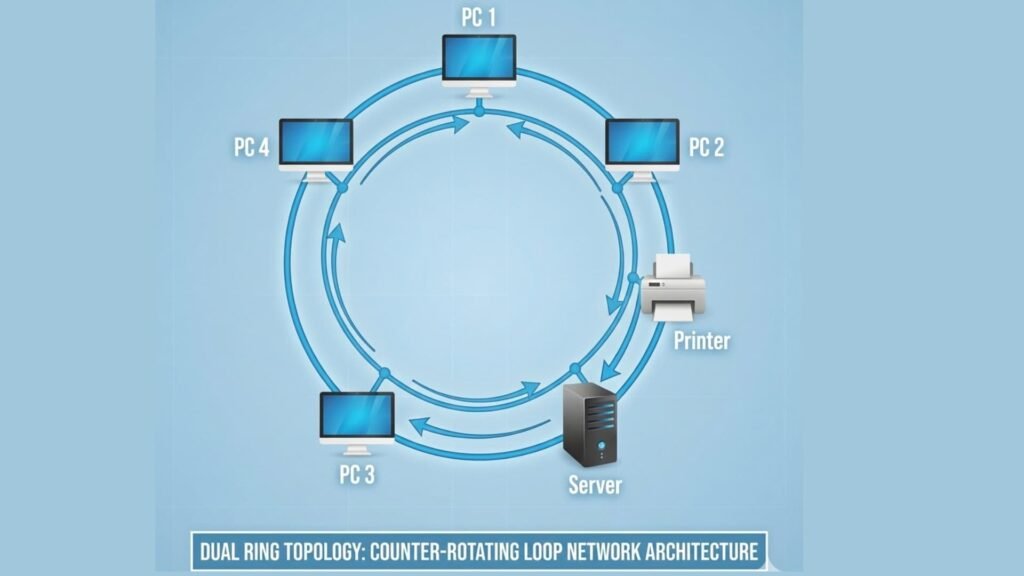
This improves fault tolerance significantly. Many industrial Ethernet networks use this design.
What are the Advantages & Disadvantages of Ring Topology?
Generally, Ring topology provides several benefits:
- Data travels through a defined path. Traffic behavior remains consistent.
- Token-based communication controls transmissions. Devices do not compete for bandwidth.
- Each node receives equal communication opportunity. No device dominates the network.
- Industrial automation requires predictable timing. Ring topology supports that requirement.
- Data moves in an organized flow. Network congestion becomes easier to manage.
- Dual rings provide failover capability. Network uptime improves.
Disadvantages of Ring Topology:
While Ring topology comes with many benefits, it also comes up with several disadvantages like-
- One cable break can stop communication. The entire ring becomes unstable.
- Faults may occur anywhere along the ring. Engineers must inspect each segment.
- Ring protocols need proper configuration. Misconfiguration can cause loops.
- Modern LANs prefer star-based designs. Ring structures are less adaptable.
- If a device fails, it may break the ring.Modern switches mitigate this risk.
Where Ring Topology Is Used Today
Ring topology still appears in specialized networks. Industrial automation is a major example. Manufacturing plants rely on deterministic communication.
Transportation systems also use ring networks. Railway communication networks benefit from predictable data flow.
Energy and power infrastructure use it as well. Substation automation networks often follow ring designs.
Industrial Ethernet technologies support ring redundancy. Protocols quickly restore communication after failure. These environments prioritize reliability over simplicity.
Ring topology is not just a historical concept. It remains useful in specialized environments. Industrial networks still rely on its predictable behavior. Redundant rings improve reliability significantly.
However, ring topology is not ideal for all networks. Enterprise LANs prefer more flexible designs. Engineers should understand where ring topology fits best. Choosing the right topology improves network stability.
A well-designed topology prevents many operational problems. That is the foundation of reliable network architecture.