
Industrial networks handle critical data in real time. These networks support automation, safety, and operational continuity. Any delay in communication can cause serious production issues. That is why Quality of Service plays a vital role.
Quality of Service, commonly called QoS, ensures smooth data flow. It prioritizes important traffic over less critical data. This helps maintain reliability in industrial communication systems. Industries like oil, gas, and manufacturing depend heavily on it.
Modern industrial networks use protocols like PROFINET and Modbus TCP. These protocols require low latency and high availability. QoS helps achieve these requirements effectively. It ensures stable communication between devices.
In industrial environments, multiple devices share the same network. These include IP cameras, sensors, PLCs, and control systems. Without QoS, network congestion can occur frequently. This leads to delays and packet loss.
QoS becomes essential when networks grow in size. It helps maintain performance even under heavy load conditions. It also ensures that critical applications always get priority. This improves overall network efficiency.
What is QoS?
Quality of Service is a network feature that manages data traffic. It controls how data packets are handled across a network. QoS ensures that critical applications receive higher priority. This improves network performance and reliability.
QoS works by classifying and prioritizing traffic. It identifies which data packets are more important. These packets are then processed faster than others. This reduces delay and improves response time.
In industrial networking, QoS is extremely important. It ensures that control signals are delivered instantly. It also prevents delays in automation processes. This helps maintain operational stability.
QoS uses several mechanisms to manage traffic. These include traffic classification, queuing, and bandwidth allocation. Each mechanism plays a specific role in traffic management. Together, they ensure smooth data transmission.
Industrial Ethernet switches often support advanced QoS features. These features allow network administrators to define priorities. For example, real-time control traffic gets the highest priority. Meanwhile, background data gets lower priority.
When using comxus 4-port industrial managed poe switch, QoS becomes even more effective. It ensures that power and data delivery remain stable. This is crucial for devices like IP cameras and wireless access points. It also improves surveillance and monitoring performance.
QoS also supports Service Level Agreements in industrial networks. It ensures consistent network performance across applications. This is important for maintaining industrial standards. It also helps in compliance with industry regulations.
How does it work?
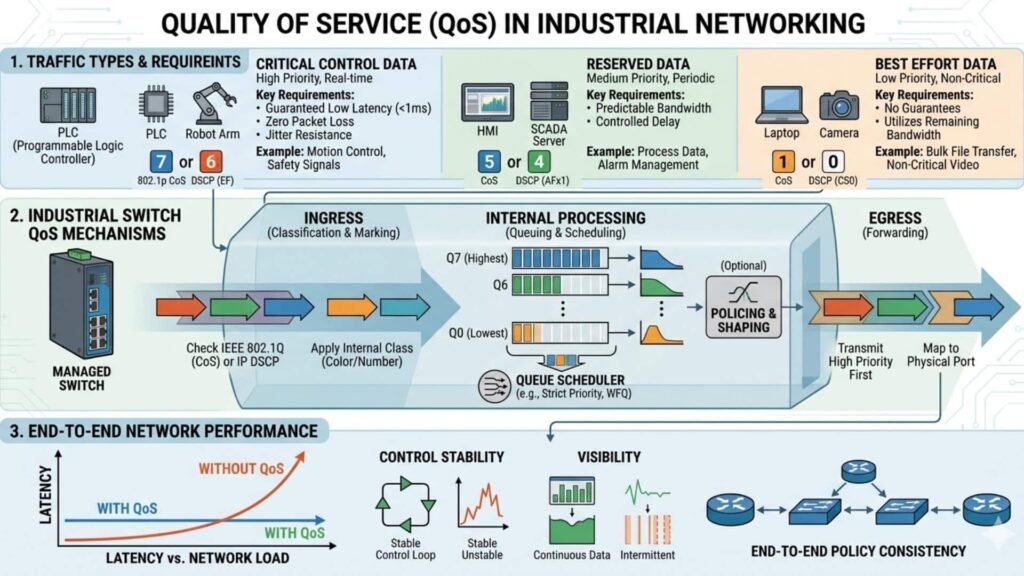
QoS works by controlling how data flows through a network. It uses several techniques to manage traffic efficiently. These techniques ensure that critical data always gets priority. Let us understand this in a simple way.
First, QoS identifies different types of network traffic. This process is called traffic classification. It separates data into categories like voice, video, and control signals. Each category has a different priority level.
Next, QoS marks the packets based on their priority. This is known as packet marking. It uses fields like DSCP or CoS to assign priority values. These values help network devices understand packet importance.
After marking, QoS uses queuing mechanisms. Packets are placed into different queues based on priority. High priority packets are processed first. Lower priority packets wait in the queue.
There are different queuing methods used in QoS. These include Priority Queuing and Weighted Fair Queuing. Priority Queuing ensures critical traffic is always served first. Weighted methods distribute bandwidth fairly among applications.
QoS also uses traffic shaping and policing. Traffic shaping controls the data rate smoothly. It prevents sudden bursts of traffic. Traffic policing limits the bandwidth usage of certain applications.
Bandwidth allocation is another key function of QoS. It reserves bandwidth for critical applications. This ensures that important data is never delayed. It also prevents network congestion during peak usage.
In industrial networks, QoS ensures real-time communication. For example, PLC signals must reach instantly. QoS ensures these signals are not delayed by other traffic. This improves system reliability.
QoS also works with VLAN tagging in industrial switches. VLANs help separate network traffic logically. QoS then prioritizes traffic within each VLAN. This improves overall network performance.
In managed industrial switches, QoS settings can be customized. Network administrators can define traffic policies. These policies control how data flows through the network. This provides better control over network performance.
QoS also reduces packet loss in congested networks. It ensures that important packets are not dropped. This is critical for industrial automation systems. It helps maintain consistent operations.
Finally, QoS continuously monitors network traffic. It adjusts priorities based on real-time conditions. This dynamic behavior ensures optimal performance. It makes industrial networks more reliable and efficient.
Advantages of Using QoS in Industrial Networking
QoS provides several benefits in industrial environments. It improves network performance and reliability. It also ensures smooth communication between devices. This is essential for critical operations.
One major advantage is reduced latency. QoS ensures that important data is delivered quickly. This is crucial for real-time applications. It helps maintain system stability.
QoS also improves bandwidth utilization. It ensures that network resources are used efficiently. This prevents unnecessary congestion. It also improves overall network performance.
Another benefit is better traffic management. QoS organizes data based on priority. This ensures that critical applications are never affected. It also improves user experience.
QoS enhances reliability in industrial systems. It ensures consistent data delivery. This reduces downtime and operational risks. It also improves productivity.
QoS supports critical applications like video surveillance. It ensures smooth video streaming without interruptions. This is important for security systems. It helps in real-time monitoring.
QoS also improves network scalability. It allows networks to handle more devices. This is important for growing industrial setups. It ensures performance remains stable.
In industrial automation, QoS ensures precise communication. It prevents delays in control signals. This helps maintain process accuracy. It also reduces errors in operations.
QoS also helps in maintaining compliance with industry standards. Many industries require reliable communication systems. QoS ensures these requirements are met. It also improves system credibility.
Another advantage is better fault tolerance. QoS helps maintain performance during network issues. It ensures critical data is still delivered. This improves system resilience.
QoS also supports integration with modern technologies. These include IoT and smart industrial systems. It ensures seamless communication between connected devices. This improves operational efficiency.
FAQ’s Related to QoS
Why is QoS important in industrial networking?
QoS ensures that critical data gets priority. It reduces delays and improves reliability. This is essential for industrial operations.
What happens without QoS?
Without QoS, all data is treated equally. This can cause delays and congestion. Critical applications may fail.
Does QoS improve network speed?
QoS does not increase speed directly. It improves how bandwidth is used. This results in better performance.
Is QoS required for CCTV systems?
Yes, QoS is important for CCTV systems. It ensures smooth video streaming. It prevents frame drops and lag.
How does QoS handle congestion?
QoS prioritizes critical traffic during congestion. It delays less important data. This ensures smooth operation.
Conclusion-
QoS is a critical feature in industrial networking. It ensures reliable and efficient data communication. It helps prioritize important applications. This improves overall system performance.
Industrial networks are becoming more complex every day. They require advanced traffic management solutions. QoS provides the necessary control and flexibility. It ensures smooth operation even under heavy load.
By implementing QoS, industries can reduce downtime. They can also improve productivity and safety. This makes QoS an essential part of modern industrial networks.
If you are designing an industrial network, QoS should be a priority. It ensures long-term reliability and performance. It also supports future scalability. This makes it a smart investment for any industrial setup.
