
Industrial networks must stay online all the time. Even a small failure can stop production. I have seen minor network issues cause major downtime. That is why network redundancy becomes very important. It helps maintain communication and keeps systems running without interruption.
What is Network Redundancy?
Network redundancy means creating backup communication paths in a network. These paths take over when the main connection fails. It ensures continuous data flow between devices.
In industrial-grade ethernet switches, redundancy prevents single points of failure. If one link goes down, another link becomes active. This switching happens automatically and very quickly.
You can think of redundancy as a safety net. It protects your network from unexpected failures. This is very useful in automation systems.
Redundancy is commonly used in ring, star, and mesh topologies. These designs allow multiple paths for data transmission.
It improves network reliability and uptime. This is critical in industrial automation and control systems.
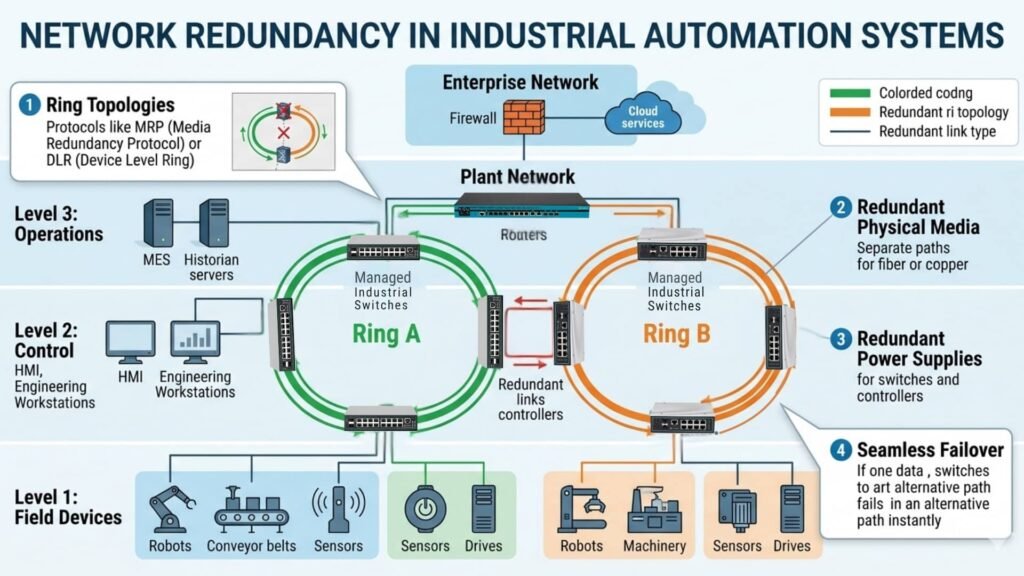
Types Of Network Redundancy:
There are different types of redundancy used in industrial networks. Each type depends on network design and application.
- Link redundancy uses multiple cables between devices. If one cable fails, the other remains active.
- Device redundancy involves backup switches or controllers. If one device fails, another takes control.
- Path redundancy ensures multiple routes for data transmission. This is common in ring and mesh networks.
- Power redundancy is also important. Many industrial switches support dual power inputs.
Each type adds an extra layer of protection. Together, they create a highly reliable network.
Why Redundancy Matters in Industrial Switches?
Industrial environments cannot tolerate downtime. Even a few seconds can impact production. I have seen factories lose hours due to network failure.
Redundancy ensures continuous communication between PLCs and devices. This is critical for real-time control systems.
It reduces the risk of network failure. Backup paths keep data flowing even during faults.
Industrial switches support fast recovery mechanisms. These can restore communication within milliseconds.
Redundancy also improves safety in critical applications. Systems like fire safety and surveillance depend on stable networks.
It helps in maintaining operational efficiency. Engineers can perform maintenance without shutting down the network.
In modern Industry 4.0 setups, redundancy is not optional. It is a basic requirement for reliable operations.
Which Protocols are Commonly Used for Redundancy in Industrial Switches?
Several protocols are used to implement redundancy in industrial networks. Each protocol has its own advantages.
Rapid Spanning Tree Protocol (RSTP):
RSTP is one of the most commonly used protocols. It stands for Rapid Spanning Tree Protocol. It provides fast recovery compared to traditional STP.
RSTP blocks redundant paths and activates them during failure. It ensures loop-free network operation.
Media Redundancy Protocol (MRP):
MRP is another important protocol. It stands for Media Redundancy Protocol. It is widely used in PROFINET networks.
MRP works in ring topology. It provides very fast recovery, usually within milliseconds.
Ethernet Ring Protection Switching (ERPS):
ERPS is also used in industrial networks. It stands for Ethernet Ring Protection Switching. It is designed for large ring networks.
ERPS offers faster recovery compared to RSTP. It is suitable for critical industrial applications.
Parallel Redundancy Protocol (PRP):
PRP is Parallel Redundancy Protocol. It sends duplicate data over two separate networks. This ensures zero recovery time.
High-availability Seamless Redundancy (HSR):
HSR is High-availability Seamless Redundancy. It is similar to PRP but works in ring topology.
Both PRP and HSR provide seamless redundancy. There is no packet loss during failure.
Choosing the right protocol depends on your network design. It also depends on performance and recovery requirements.
Key Factors to Consider When Implementing Redundancy
You should always plan redundancy based on application needs. Not every network requires the same level of protection.
Consider network topology before selecting a protocol. Ring and mesh designs support better redundancy.
Check recovery time requirements. Critical systems need faster failover.
Also, evaluate switch compatibility with redundancy protocols. Not all switches support advanced features.
Proper planning ensures reliable and efficient network performance.
Common Benefits of Using Network Redundancy in Industrial Environment
Network redundancy improves overall system reliability. It ensures continuous communication during failures.
It reduces downtime and production losses. This is very important in industrial automation.
Redundancy also improves network performance and stability. It allows maintenance without stopping operations.
It enhances safety in critical systems. Applications like surveillance and fire systems depend on it.
Overall, it creates a robust and future-ready network.
Conclusion
Network redundancy is a key part of industrial networking. It ensures reliability, safety, and continuous operation. I always recommend including redundancy in network design. It protects systems from failure and improves performance. In modern industries, redundancy is essential for stable and efficient operations.
