
Device redundancy is a key concept in industrial networking. It ensures system availability when a device fails. I have seen entire systems stop due to one faulty switch. That is why backup devices are always recommended in critical networks.
What is Device Redundancy?
Device redundancy means using backup network devices in parallel with primary devices. These backup devices take over when the main device fails. It ensures continuous operation without manual intervention.
In industrial networks, this usually involves switches, routers, or controllers. If one device stops working, the secondary device becomes active. This process is automatic and very fast.
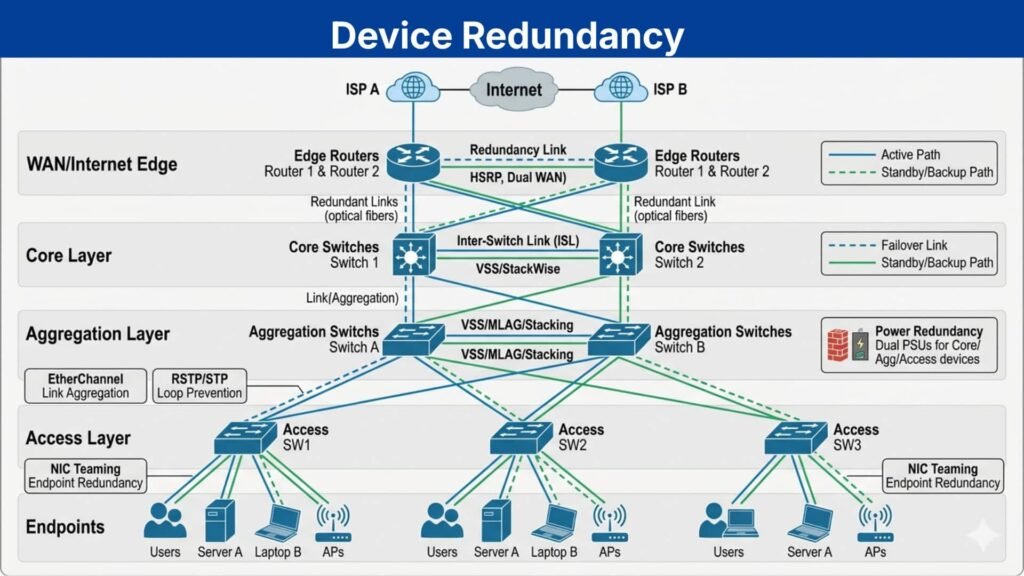
Device redundancy eliminates single points of failure. It is widely used in mission-critical applications. This includes manufacturing plants and power systems.
How Device Redundancy Works?
Device redundancy works by maintaining two or more devices in a network. One device operates as the primary unit. The other device stays in standby or active mode.
When the primary device fails, the backup device takes control. This transition is called failover. It happens within milliseconds in modern systems.
Protocols and synchronization mechanisms ensure both devices stay updated. This helps the backup device take over smoothly.
In some setups, both devices work simultaneously. This is called active-active redundancy.
Difference Between Link Redundancy and Device Redundancy
Link redundancy and device redundancy both improve network reliability. However, they work at different levels. I often explain this difference during network design discussions.
- Link redundancy focuses on communication paths. It uses multiple cables or links between devices. If one link fails, another link takes over.
- Device redundancy focuses on hardware backup. It uses duplicate switches, routers, or controllers. If one device fails, another device becomes active.
- In link redundancy, the device remains the same. Only the path changes during failure. In device redundancy, the entire device is replaced during failover.
- Link redundancy is faster to implement and more cost-effective. It is commonly used in ring and mesh topologies. It protects against cable or port failure.
- Device redundancy provides deeper protection. It handles complete hardware failure. This includes switch crashes or power issues.
- In critical systems, both methods are used together. Link redundancy protects connectivity, while device redundancy protects hardware.
From my experience, combining both ensures maximum network uptime. It creates a highly reliable and fault-tolerant industrial network.
Types of Device Redundancy
There are different types of device redundancy used in industrial environments. Each type depends on system requirements.
- Active-Passive Redundancy uses one active device and one standby device. The standby activates during failure.
- Active-Active Redundancy uses both devices simultaneously. This improves performance and load sharing.
- Controller Redundancy is used in PLC systems. A backup controller takes over if the main controller fails.
- Switch Redundancy involves using multiple industrial switches. This ensures network continuity during hardware failure.
Each type provides different levels of reliability and performance.
Why Device Redundancy Matters in Industrial Networks
Industrial operations depend on continuous system availability. Even a small failure can stop production. I have seen downtime cause major financial losses.
Device redundancy ensures uninterrupted communication. It keeps networks running even during hardware failure.
It also improves system safety. Critical applications require reliable network infrastructure.
Redundancy allows maintenance without shutting down operations. Engineers can replace faulty devices without affecting production.
In Industry 4.0 environments, device redundancy is essential. It supports automation and real-time data processing.
Common Protocols Used in Device Redundancy
Several protocols are used to manage device redundancy in industrial networks. These protocols ensure smooth failover.
- VRRP (Virtual Router Redundancy Protocol) is commonly used. It allows multiple routers to act as one virtual device.
- HSRP (Hot Standby Router Protocol) is another option. It provides automatic failover between devices.
- PRP (Parallel Redundancy Protocol) ensures zero downtime. It sends duplicate data across two devices.
- HSR (High-availability Seamless Redundancy) works in ring topology. It provides seamless communication without interruption.
These protocols improve reliability and reduce failover time.
Key Factors to Consider When Implementing Device Redundancy
Proper planning is important for device redundancy. I always recommend evaluating system requirements first.
Choose compatible devices that support redundancy protocols. Not all devices offer the same features.
Consider failover time and system criticality. Critical systems need faster recovery.
Ensure proper synchronization between devices. This helps in smooth transition during failure.
Also, plan for power redundancy and network design.
Benefits of Device Redundancy
Device redundancy improves network reliability and uptime. It ensures continuous operation during failures.
It reduces downtime and production losses. This is critical in industrial automation.
It enhances system safety and performance. Backup devices ensure stable communication.
It also supports maintenance without disruption. Engineers can work without stopping the system.
Overall, it creates a robust and fault-tolerant network.
Conclusion-
Device redundancy is essential for modern industrial networks. It ensures reliability, safety, and continuous operation. I always recommend implementing redundancy in critical systems. It protects against failures and improves performance. In today’s industrial environment, device redundancy is a necessity, not an option.
