
Bus topology is one of the oldest network designs. Every networking professional learns it early. Yet many underestimate its impact and limitations.
This topology shaped early Ethernet networks. It also shaped many troubleshooting lessons. Understanding bus topology still matters today.
Not because we deploy it often. But because we still encounter its legacy. Let us break it down properly.
What Is Bus Topology?
Bus topology uses a single shared communication cable. This cable is called the backbone. All network devices connect directly to this backbone. There is no central switch or hub.
Each device listens to the same medium. Data travels in both directions along the cable. Terminators sit at both cable ends. They prevent signal reflection and data corruption.
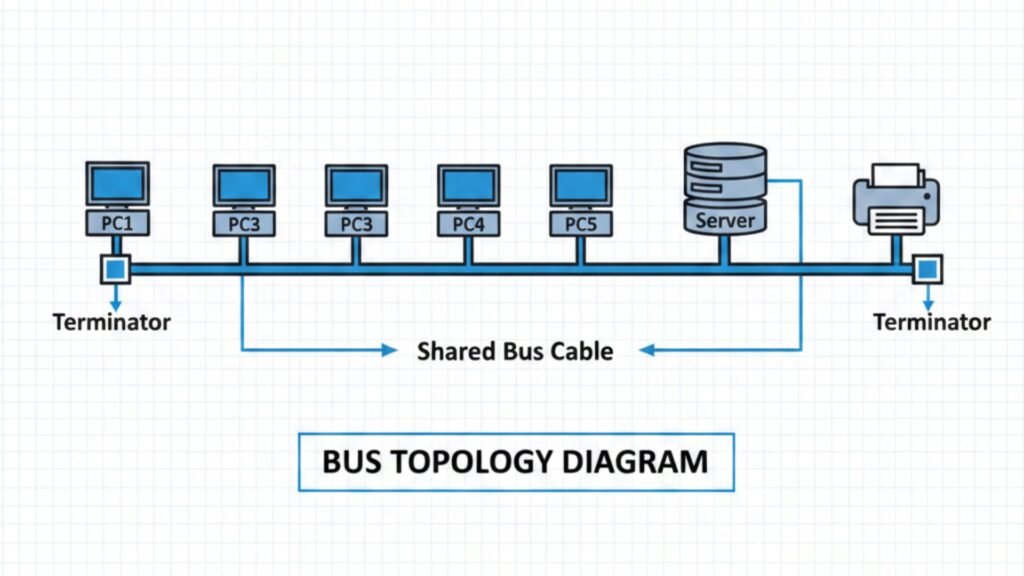
If terminators fail, communication breaks. This detail is often overlooked.
How Bus Topology Works?
When a device sends data, all devices receive it. Each device checks the destination address. Only the intended device processes the data. Others discard it. This creates a shared broadcast environment. There is no traffic isolation. Only one device should transmit at a time. Otherwise, collisions occur.
Early Ethernet used CSMA/CD. It helped detect and manage collisions. As traffic increases, collisions increase. Performance drops quickly.
Key Components of Bus Topology-
Although, Bus topology looks very simple but it’s components are very crucial. Each of them has their own dedicated job.
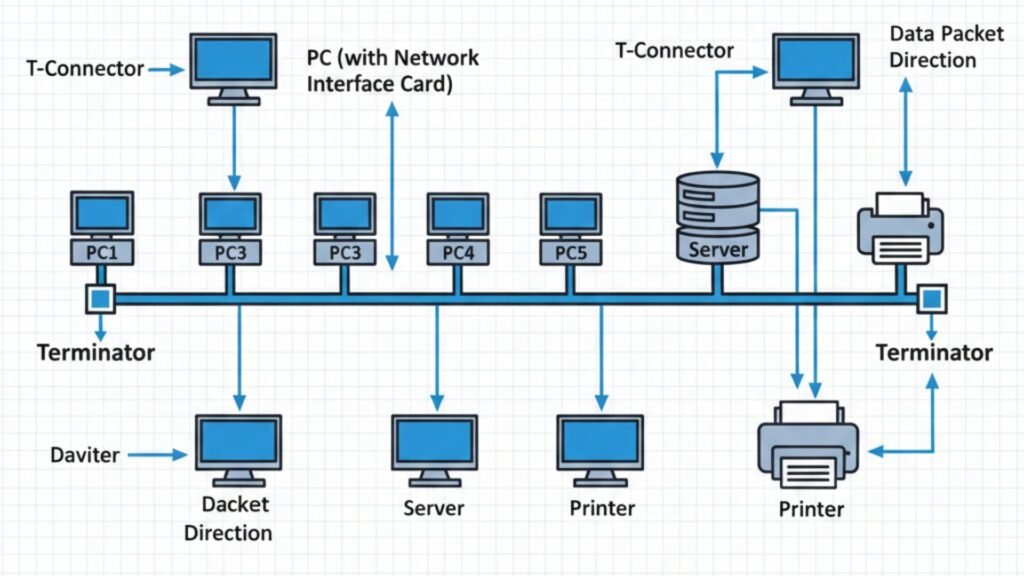
Backbone cable:
This is the main communication path. In the earlier phase of networking, we were using the coaxial cable for backbone of the network.
Network nodes:
when we talk about network nodes, these are generally end devices like- computers printers and servers. Each node in the bus topology is connected to the backbone cable.
T-connectors or taps:
T-connections or taps are used to connect the devices to the Backbone. When we connect at device to the coaxial cable, we have to make sure that it connected properly. Poor connections cause signal loss.
Terminators:
Terminators are responsible for observing signals at the cable ends. Missing terminator can break the network.
What are the types of bus topology?
Bus topology generally comes in two forms:
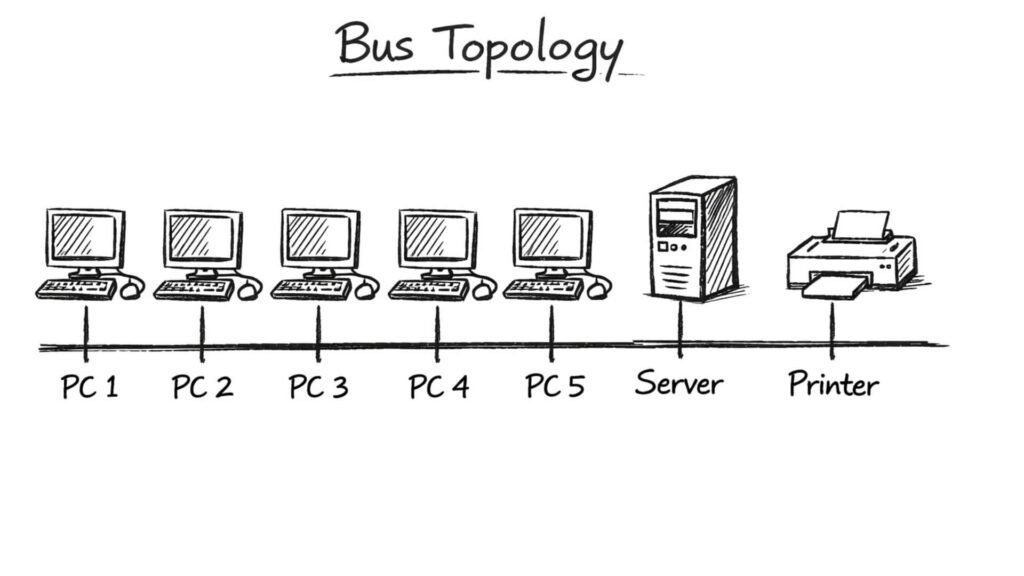
Lenear bus topology:
This is the classic bus topology design. In this type of topology all devices are connected along single side of cable. Meanwhile terminators exist at the both ends.
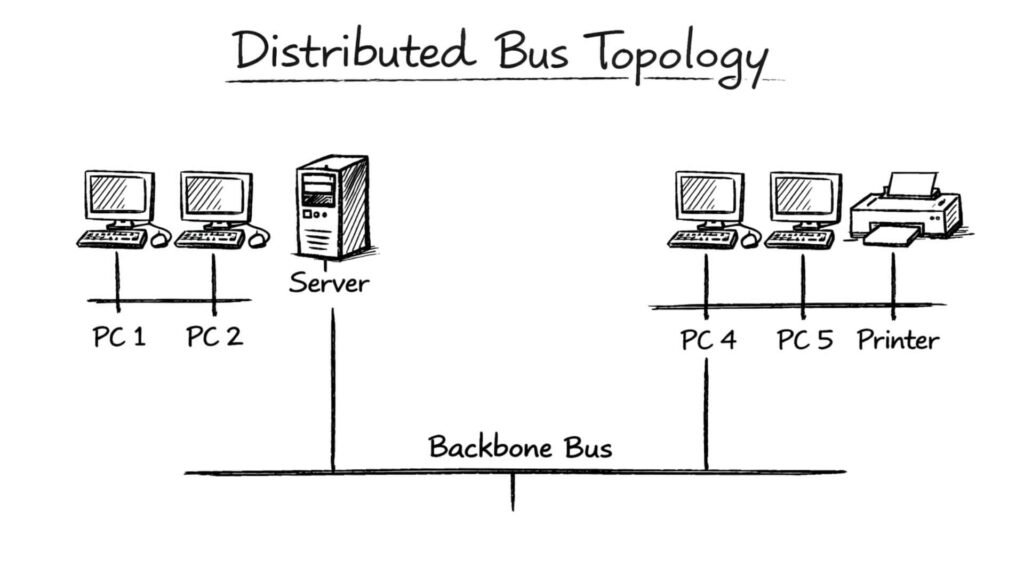
Distributed Bus Topology:
In distributed bus topology, multiple bus segments connect together. Each segment still follows bus principles. This is a little complex design, so risk of network failure remains high.
What are the Advantages and Disadvantages of bus topology-
I believe now you have a clear idea about what is bus topology and how does it work. Now let’s talk about the benefits of this topology.
- Bus topology requires minimum cabling structure. Also it doesn’t require switch of hub. Due to which, it becomes cost effective.
- Bus topology designs are easy to understand. You don’t need a complex documentation. So it becomes easy to maintain.
- Just because, it doesn’t need a centralized device, bus topology becomes easy choice for small network. because, it is quick to deploy in the small network. also, it is suitable for temporary network.
Disadvantages of bus topology –
- The backbone cable is the important part of the technology. If it breaks, entire network will be broken.
- Bus topology has a poor fault isolation, If cable is faulty, it may take a time to detect the fault. So troubleshooting may take little longer time.
- Bus topology doesn’t use a switches of hub. Due to which, you cannot manage the devices in the network. so if you add more devices in the network, it will cause more collision. Also, the latency may become unpredictable.
- Adding a device in the network increases instability. Also, cable length limits growth.
- In bus topology, all traffic is visible to every node. So packet sniffing becomes very easy.
- Last but not least, this topology is not suitable for modern network. when you use bus topology, high bandwidth application may struggle. Due to which, Real-time systems fail under load. These limitations are serious. They explain why bus topology faded.
Where can you still found bus topology?
Although, bus topology is rarely being used in the modern era. Still, you can found it in the some applications like-
- Industrial areas- where system works only on bus topology.
- legacy fieldbus systems
- Small offices where 4 to 5 pcs are only being used.
Although, Bus topology belongs to networking history. But history still matters.
Engineers must understand it clearly. Legacy systems still exist.
Knowing bus topology improves design judgment. It sharpens troubleshooting skills.
You may never deploy it again. But you will respect why it failed.
And that makes you a better network engineer.
