
Power over Ethernet (PoE) has transformed industrial networking. It allows both power and data transmission through a single Ethernet cable. This reduces wiring complexity and installation costs.
In industrial environments, reliability and efficiency are critical. Choosing the right PoE standard ensures stable operation of connected devices. This article explains the differences between PoE, PoE+, and PoE++ in a simple and practical way.
What is Power over Ethernet (PoE)?
Power over Ethernet is a technology that delivers electrical power through network cables. It eliminates the need for separate power supplies. This makes deployment faster and more flexible.
PoE is widely used in industrial automation, surveillance systems, and smart infrastructure. Devices like IP cameras, access points, and sensors depend on it. It also improves system scalability.
Why PoE is Important for Industrial Applications
Industrial networks operate in demanding environments. They require reliable and continuous power supply. PoE helps meet these requirements efficiently.
It reduces cable clutter in control panels and field installations. This improves maintenance and troubleshooting. It also supports centralized power management.
In applications like oil and gas or manufacturing plants, downtime is costly. PoE ensures consistent device performance and uptime.
Understanding PoE Standards
PoE technology follows IEEE standards. Each standard defines power delivery limits and performance capabilities. Understanding these standards is essential for proper network design.
The three major standards are:
- IEEE 802.3af (PoE)
- IEEE 802.3at (PoE+)
- IEEE 802.3bt (PoE++)
Each version increases power capacity and supports more advanced devices.
What is Standard PoE (IEEE 802.3af)?
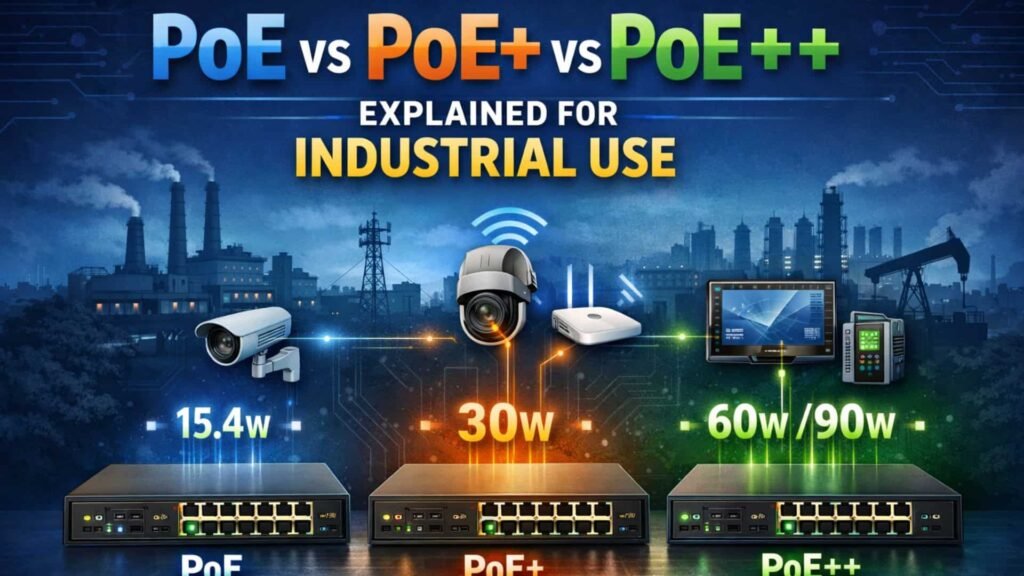
Standard PoE, also known as IEEE 802.3af, is the basic version. It delivers up to 15.4W per port. However, actual usable power at the device is around 12.95W.
This standard is suitable for low-power devices. These include basic IP cameras, VoIP phones, and simple sensors. It works well in small-scale industrial setups.
PoE is cost-effective and energy-efficient. However, it may not support high-power industrial devices.
What is PoE+ (IEEE 802.3at)?
PoE+ is an upgraded version of standard PoE. It delivers up to 30W per port. The usable power at the device is around 25.5W.
This makes it suitable for more demanding devices. These include PTZ cameras, wireless access points, and advanced IoT devices.
PoE+ is widely used in modern surveillance systems. It provides better flexibility and performance compared to standard PoE.
For industrial use, PoE+ is often the minimum requirement. It supports most mid-level applications efficiently.
What is PoE++ (IEEE 802.3bt)?
PoE++ is the latest and most powerful standard. It supports two types:
- Type 3 – Up to 60W per port
- Type 4 – Up to 90W per port
This standard is designed for high-power devices. These include industrial displays, access control systems, and high-end PTZ cameras.
PoE++ uses all four pairs of Ethernet cables. This allows higher power transmission. It is ideal for advanced industrial environments.
Key Differences Between PoE, PoE+, and PoE++?
Understanding the differences helps in selecting the right solution.
- Power Delivery Capacity: PoE provides up to 15.4W. PoE+ increases this to 30W. PoE++ goes up to 90W. Higher power supports more complex devices.
- Cable Pair Usage: PoE and PoE+ use two pairs of cables. PoE++ uses all four pairs. This improves efficiency and power delivery.
- Device Compatibility: PoE works with basic devices. PoE+ supports moderate power devices. PoE++ is required for high-performance equipment.
- Industrial Application Scope: PoE is suitable for small deployments. PoE+ fits medium-scale systems. PoE++ is ideal for large industrial networks.
PoE vs PoE+ vs PoE++ in Industrial Use Cases
Let’s explore how these standards are used in real industrial scenarios.
- CCTV Surveillance Systems: Basic cameras work on PoE. However, PTZ cameras require PoE+. High-end AI cameras may need PoE++.
- Industrial Automation: Sensors and controllers may run on PoE. Advanced automation devices often need PoE+. Heavy equipment interfaces require PoE++.
- Wireless Connectivity: Access points in factories usually require PoE+. High-performance Wi-Fi 6 devices may need PoE++.
- Smart Cities and Infrastructure: Traffic systems and smart lighting may use PoE+. Digital signage and control panels often need PoE++.
Power Budget Considerations in Industrial Networks
Power budget plays a critical role in PoE deployment. It defines how much total power a switch can deliver.
For example, an 8 port PoE switch may have a 120W budget. You must calculate total device consumption carefully.
If total demand exceeds the budget, devices may fail. This can impact critical operations.
Always keep a safety margin of at least 20%. This ensures stability and future scalability.
Advantages of Using PoE in Industrial Environments
PoE offers several benefits for industrial networks.
- Simplified Installation: Only one cable is required for power and data. This reduces installation time and cost.
- Centralized Power Management: Power can be controlled from a central switch. This improves monitoring and efficiency.
- Improved Reliability: Industrial PoE switches are designed for harsh conditions. They support wide temperature ranges and rugged environments.
- Scalability: New devices can be added easily without major changes. This supports network expansion.
How to Choose Between PoE, PoE+, and PoE++
Selecting the right standard depends on your application.
- Use PoE for low-power devices
- Use PoE+ for moderate power requirements
- Use PoE++ for high-power industrial equipment
Always consider device requirements and future scalability. Choosing the right option ensures long-term reliability.
Conclusion-
PoE technology has become essential in industrial networking. It simplifies deployment and improves efficiency.
Understanding the differences between PoE, PoE+, and PoE++ is crucial. Each standard serves a specific purpose.
For industrial use, PoE+ and PoE++ are more commonly used. They support modern devices and high-performance applications.
By selecting the right PoE standard and planning power budget carefully, you can build a reliable and scalable network. This ensures smooth operations in even the most demanding environments.
