
In modern industrial networks, managing data traffic efficiently is critical. Whether it’s a manufacturing plant, oil refinery, or smart city infrastructure, multiple systems like CCTV surveillance, SCADA, access control, and IoT devices operate on the same network. Without proper segmentation, this can lead to congestion, security risks, and performance issues.
This is where VLAN (Virtual Local Area Network) plays a vital role. VLAN in industrial Ethernet switches helps divide a single physical network into multiple logical networks, improving performance, security, and control. For industries that rely on real-time data and uninterrupted communication, VLAN is not just a feature it is a necessity.
What is VLAN?
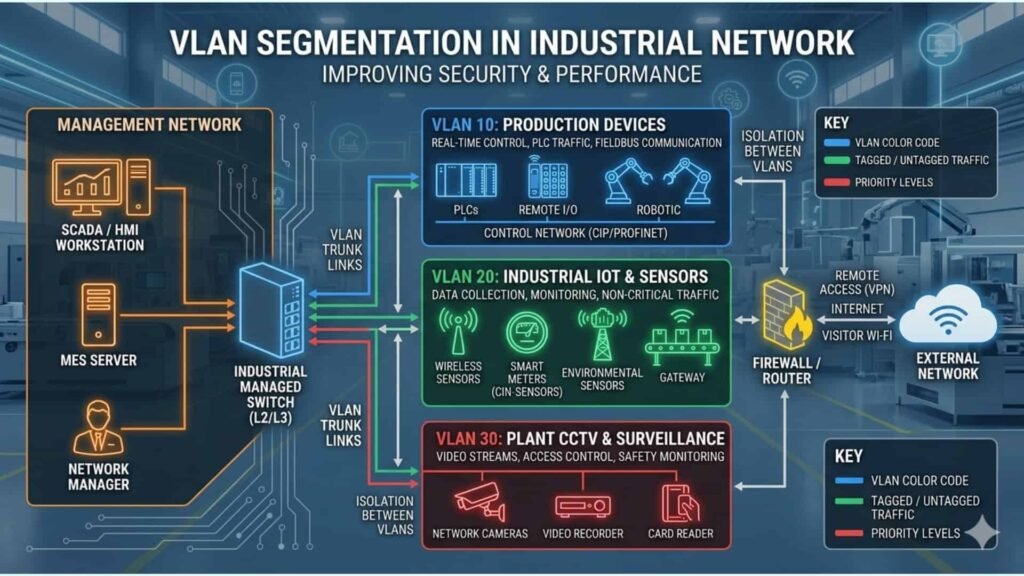
A VLAN (Virtual Local Area Network) is a technology that allows you to segment a physical network into multiple logical networks. Devices in different VLANs cannot communicate directly unless configured through routing.
In simple terms, VLAN creates separate “virtual networks” within the same switch. For example:
- CCTV cameras can be placed in one VLAN
- Industrial automation systems in another
- Office IT network in a separate VLAN
Even though all devices are connected to the same industrial Ethernet switch, VLAN ensures that their traffic remains isolated.
Key Characteristics of VLAN:
- Logical segmentation of networks
- Improved network security
- Reduced broadcast traffic
- Better traffic management
This segmentation is especially useful in industrial environments where multiple critical systems run simultaneously.
How does it work?
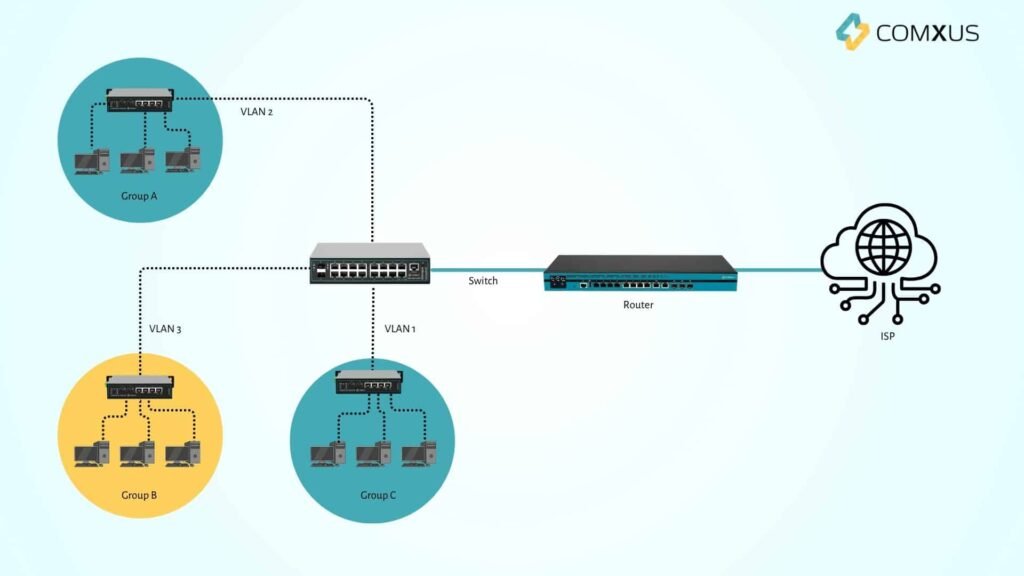
VLAN works by assigning a VLAN ID (VID) to each network segment. Industrial Ethernet switches use this ID to identify which data belongs to which VLAN.
Basic Working Principle:
- Each port on the switch is assigned to a VLAN
- When a device sends data, the switch tags it with a VLAN ID
- The switch forwards the data only to ports within the same VLAN
- Devices in other VLANs cannot access this traffic
Types of VLAN Configuration:
- Port-Based VLAN: Each port is manually assigned to a VLAN
- Tagged VLAN (802.1Q): Data packets carry VLAN tags for identification
- Untagged VLAN: Used for end devices that do not understand VLAN tagging
Example in Industrial Setup:
- VLAN 10 → CCTV cameras
- VLAN 20 → SCADA systems
- VLAN 30 → Office network
This ensures that heavy video traffic from CCTV does not affect SCADA communication, which requires real-time performance.
Why is Vlan required in Industrial Ethernet Switches?
Industrial environments are very different from standard office networks. They demand high reliability, real-time communication, and strong security. VLAN plays a crucial role in achieving these requirements.
1. Network Segmentation
Industrial networks often connect multiple systems such as PLCs, HMIs, IP cameras, and sensors. VLAN separates these systems logically, preventing unnecessary interaction.
2. Improved Security
By isolating network segments, VLAN reduces the risk of unauthorized access. For example, CCTV traffic can be isolated from critical control systems like SCADA.
3. Reduced Network Congestion
Broadcast traffic is limited within each VLAN. This reduces network load and improves performance, especially in environments with high data traffic.
4. Better Network Management
Administrators can easily manage and troubleshoot networks by grouping devices logically instead of physically.
5. Support for Real-Time Applications
Industrial protocols like PROFINET, Modbus TCP, and EtherNet/IP require stable communication. VLAN ensures minimal interference from other network traffic.
6. Scalability
As industrial networks grow, VLAN makes it easier to add new devices without redesigning the entire network.
What Are the Advantage and Disadvantages of Industrial Ethernet Switches?
Advantages of industrial switches:
- High Reliability: Industrial Ethernet switches are designed for harsh environments. They can operate in extreme temperatures, dust, and vibration, making them suitable for factories and outdoor deployments.
- VLAN Support for Traffic Segmentation: With VLAN capability, these switches provide better control over network traffic, ensuring critical systems get priority.
- Enhanced Security: Features like VLAN, ACL, and port security help protect industrial networks from cyber threats.
- Redundancy Support: Industrial switches often support ring topology protocols like ERPS or RSTP, ensuring zero or minimal downtime.
- Long Lifecycle: Compared to commercial switches, industrial switches offer longer operational life and stable performance.
- PoE Integration: Many industrial switches support PoE, enabling power and data transmission over a single cable ideal for CCTV and wireless devices.
Disadvantages of industrial switches:
- Higher Cost: Industrial Ethernet switches are more expensive than regular switches due to rugged design and advanced features.
- Complex Configuration: Setting up VLANs and industrial protocols requires technical expertise.
- Limited Availability of Skilled Professionals: Not all IT teams are familiar with industrial networking standards, which can make deployment challenging.
- Over-Specification for Small Networks: For small setups, industrial switches may offer more features than required, increasing unnecessary costs.
Conclusion-
VLAN is a fundamental feature in industrial Ethernet switches that enables efficient, secure, and organized network communication. By segmenting networks logically, VLAN ensures that critical systems like SCADA, CCTV, and automation devices operate without interference.
In industrial environments where downtime can lead to significant losses, VLAN helps maintain performance, reduce congestion, and enhance cybersecurity. When combined with the rugged capabilities of industrial Ethernet switches, it becomes a powerful solution for modern infrastructure.
If you are designing or upgrading an industrial network, implementing VLAN is not optional it is a strategic requirement for ensuring reliability, scalability, and long-term performance.
